Major Arcana · XVI
The Tower
Tarot card meaning: upright, reversed and the symbols of the Olivia image
The Tower marks a sudden break in a structure you relied on, when a flash of truth knocks off whatever was balanced on top.
- Upright
- sudden changerevelationbreakthroughcollapse of pretencereleaseclearing
- Reversed
- resisted changeinner upheavalslow crumblingfear of collapsedelayed truthaftershock
Upright
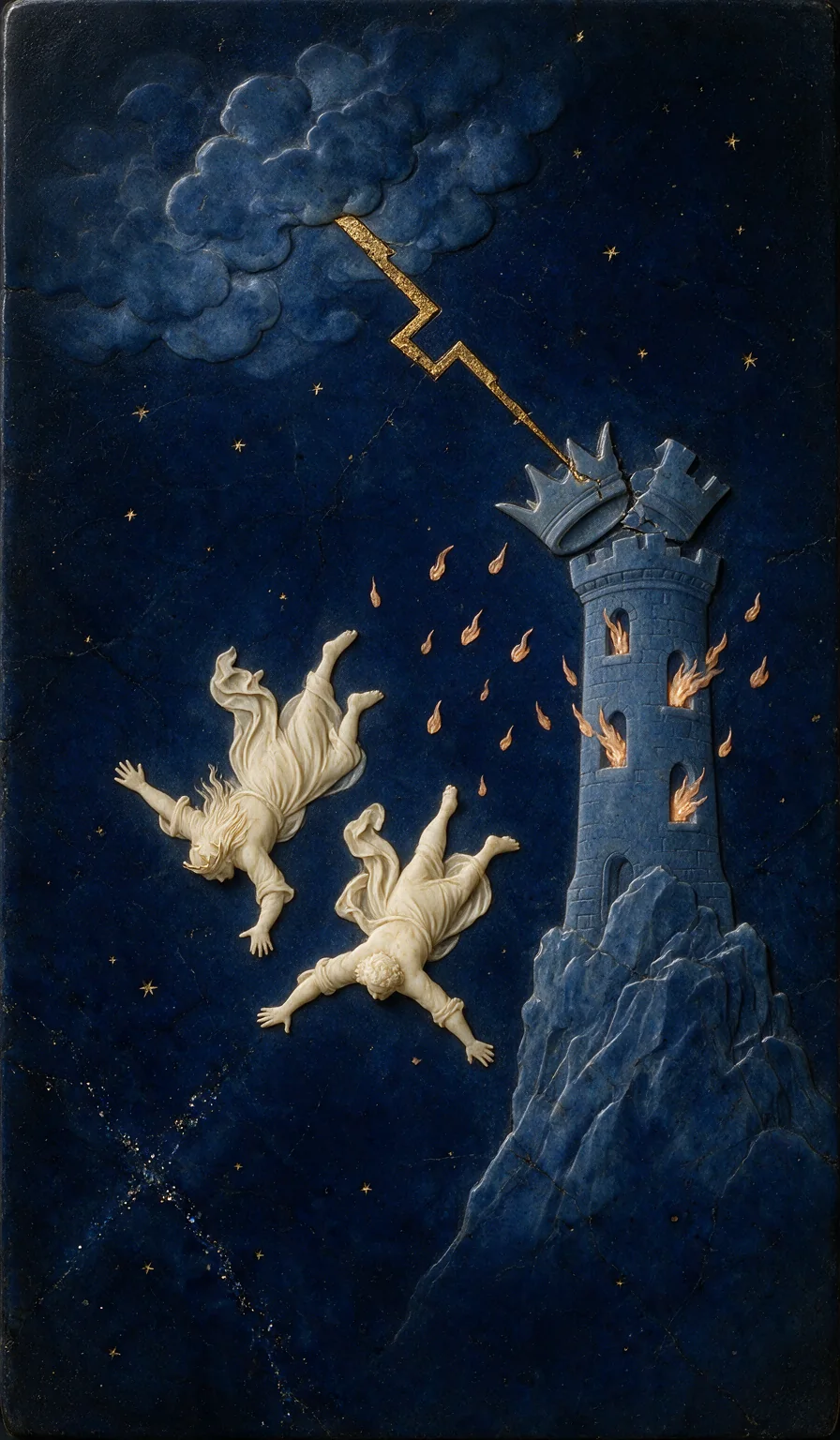
The Tower is a symbolic card about sudden change, not a forecast of disaster. It draws attention to a structure you have been living inside, a plan, a belief, an arrangement, a self-image, at the moment a flash of truth reaches it. Look at where the gold lightning lands in Olivia’s image: not at the foundations but at the crown, which tips off the battlements while a fragment of stone breaks away beside it. The walls still stand. What falls first is whatever was placed on top: an assumption, a claim to control, a story that everything was fine.
Inside, fire already shows at the arched windows, and loose flames scatter through the sky like embers. The change is not only a blow from outside; something within the structure had been burning for a while. Two ivory figures fall head first beside the tower, one still wearing a small crown, the other bareheaded with open hands. The card does not ask you to pretend this is comfortable. It asks what the flash has made visible that you could not see before.
Below everything, the crag is broad and solid, larger than the tower itself. The Tower invites you to notice what remains standing after a shock, and to build your next step on that rather than on the part that has already fallen.
Reversed
The Tower reversed points to upheaval that is resisted, delayed or happening mostly inside. You may sense the crack in a structure but keep propping it up, spending energy to keep the crown balanced on walls that have already shifted. Or the change may be taking place quietly, as a private loss of belief that nobody else can see yet.
It can also describe the aftermath: the flash has passed and you are standing among the pieces, unsure what to rebuild. The reversed card asks for honesty in small doses. Name one thing you already know is no longer true, and let that single piece come down gently rather than holding the whole weight in place.
Read the image
Every element below is carved into this card. Scroll, hover or press a number to follow it on the image.
The gold lightning bolt
What you seeA bolt of inlaid gold leaves the underside of the cloud, zigzags down to the right and strikes the crown at the tower’s summit, where a thread of gold runs on into a crack in its band.
What it carriesLightning is the classic image of a sudden insight or a truth that arrives from outside a closed system. It is the brightest gold on this card and it touches only the crown, so the strike is aimed at what sits on top: a claim, a certainty, a pretence of control.
Follow this symbol through the deck ↗The heavy storm cloud
What you seeAcross the upper left, a large cloud is carved in raised, lighter blue lapis, its rounded billows stacked in layers. The bolt emerges from its lower edge rather than from open sky.
What it carriesStorm cloud and bolt are commonly read together: tension that gathers slowly and out of sight, then discharges in a single instant. The cloud is a reminder that whatever breaks the tower does not come from nowhere; it has been building for a while.
Follow this symbol through the deck ↗The crown knocked askew
What you seeAt the summit a pointed crown of grey-blue lapis tips sideways off the battlements where the bolt hits it. Beside it, a cracked, crenellated fragment of the tower’s top breaks away to the right.
What it carriesThe crown lifted off the tower is a traditional detail, commonly read as authority or certainty placed on top of a structure rather than built into it. Here the crown is stone, not gold: it looked like sovereignty but was made of the same material as the walls.
Follow this symbol through the deck ↗The lapis tower
What you seeA tall tower of fitted lapis blocks rises on the right, topped with battlements. Its walls are carved stone by stone, and a dark arched opening sits low on its wall, half hidden by rock.
What it carriesThe tower is the classic image of any structure built to protect or impress: a belief, a role, a way of arranging life. It is often compared with the Tower of Babel. Here, as in the traditional image, the walls still stand; what breaks is the top, which keeps attention on what was placed above the foundations.
Follow this symbol through the deck ↗The scattered tongues of flame
What you seeSmall copper-gold flames, shaped like teardrops with flickering tips, are scattered across the dark sky between the tower and the falling figures, most to the left of the walls, a few to the right.
What it carriesIn the Waite-Smith lineage these drops are usually drawn in the shape of the Hebrew letter Yod, often read as a spark of divine or creative fire; Olivia carves them as plain flames rather than letter shapes. Scattered like embers, they suggest insight arriving in pieces, gathered one at a time.
Follow this symbol through the deck ↗Fire in the windows
What you seeFour arched windows on the tower’s face are lit from within by copper-gold flames, one spilling out over its sill. The lower arched opening, near the rock, stays dark.
What it carriesFire inside the windows shows that the change is not only a blow from outside: something within the structure is already alight. Flame is traditionally linked with will and energy, and here it burns through the openings, the places where the inside meets the world.
Follow this symbol through the deck ↗The crowned falling figure
What you seeOn the left, an ivory figure falls head first with long hair streaming and a small gold-tinged crown still on the head. One arm stretches out, the other reaches down; the robe billows above bare feet.
What it carriesTwo figures fall in the traditional card, and one is crowned, commonly read as the part of you that ruled from the top of the tower. Here the crown has stayed on through the fall, as if a title or identity is the last thing to let go.
The bareheaded falling figure
What you seeBelow and to the right, a second ivory figure with short curled hair falls head first, arms flung wide and hands open, legs lifted high. Cloth bands gather at both wrists.
What it carriesThe second figure has no crown and falls with open hands, not grasping. It can be read as the ordinary self that simply lived inside the tower. The spread arms can look like surrender or like the first shape of flight; the card leaves that open.
The jagged crag
What you seeThe tower stands on a steep, faceted crag of paler blue lapis that fills the lower right and runs to the card’s bottom edge, its planes cut sharply and crossed by fine cracks.
What it carriesA tower on a lonely peak is the traditional image of height reached at the cost of isolation. The crag here is broad and solid, larger than the tower itself, and it invites the thought that what lies beneath your structures may be sturdier than the structures are.
Follow this symbol through the deck ↗
The number
The Tower is card XVI. It follows The Devil, where two figures stand chained by habit, and breaks that stillness from above. It also opens the celestial run of the Major Arcana: after the Tower come The Star, The Moon and The Sun, cards named for lights in the sky rather than for buildings. Sixteen reduces to seven, the number of The Chariot, where a victory is built and driven forward; here that constructed triumph is tested. The step asks you to let a false shelter go so that the sky can be seen.
The tradition
In the Golden Dawn system The Tower is Atu XVI, titled “The Lord of the Hosts of the Mighty”. It is assigned the Hebrew letter Peh, meaning mouth, and the planet Mars, on the path joining Netzach and Hod on the Tree of Life. Marseille decks call it La Maison Dieu, the House of God, while early Italian sources name it the Arrow or the Lightning. It is one of the cards missing from the surviving Visconti-Sforza decks. Pamela Colman Smith’s 1909 design shows a crown struck from a tower on a peak, two figures falling, one crowned, and Yod-shaped flames in the air: the pattern Olivia’s image follows.
Love, work and self
- Love
- In close relationships The Tower draws attention to a pattern held up by something unspoken: a role, an agreement nobody questions, a picture of the bond that no longer matches daily life. It does not say a relationship is ending. It asks what a sudden honest moment has already shown you, and what could be rebuilt on that. With yourself, it may mean letting a flattering self-image fall so that a truer one has room to breathe.
- Work
- At work or in study, The Tower can point to a plan, method or position that has been kept standing mostly by habit or by appearances. A changed brief, a piece of feedback or a mistake may have exposed its weak point. The card invites you to separate what actually failed from what still works. In money matters, it suggests checking assumptions calmly and slowly, rather than answering the shock with sudden moves.
- Self
- For your own growth, The Tower asks which certainty you have been wearing like the crown on its summit: being the capable one, never needing help, always knowing the plan. When such a certainty is knocked loose, fear and relief can arrive together. Notice both. The broad crag beneath the tower is a reminder to look for the ground that remains once a story about yourself has fallen.
In a spread
Read the card through each position before you look at Olivia’s version. A position is a question, and the same card answers each one differently.
The situation
What aspect of the situation deserves attention?
Olivia’s readingAt the centre of a question, The Tower suggests that something has perhaps already shifted: a truth may have come out, or a structure shown its crack. The question may be about what to do with what you can now see.
What complicates it
What tension or assumption deserves a closer look?
Olivia’s readingAs a challenge, The Tower can show the effort of holding up something that no longer stands on its own, or the shock of a change that has not yet been absorbed.
A helpful next step
What small action could help you understand or respond?
Olivia’s readingAs advice, The Tower invites you to let one false support go deliberately: correct a story, admit a mistake, drop a pretence. A small break you choose is easier to rebuild from.
In conversation with
- The Tower + The Devil
With The Devil, the card before it, the chains of habit meet the lightning that breaks them. Together they ask whether the structure now shaking is one that kept you safe, or one that kept you bound.
- The Tower + The Star
With The Star, which follows, the storm clears into open sky. Together they draw attention to the calm after a break: the small gold stars already scattered across this card’s night point quietly toward the next card.
- The Tower + Death
With Death, two paces of change meet: the Tower’s sudden flash and Death’s slow transition, carried at a horse’s walk. Together they invite you to notice whether something is ending all at once or gradually, and how you want to meet each.
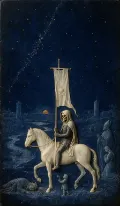
Also read withThe EmperorAll pairs ↗
Questions to keep
- What structure in your life has been held up mostly by habit, appearance or hope?
- If a crown is being knocked loose right now, what certainty or role does it stand for?
- After the shock, what still stands under you as solidly as the crag beneath this tower?
Ask them with three cards ↗A three-card reading in which each position asks one of these questions.
A small practice
Draw a simple tower, write one belief that no longer holds on its crown, then write on its base one thing you know is still true.
Cards that share its symbols
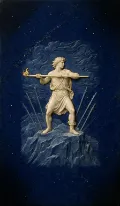 Seven of WandsShares: The scattered tongues of flame · The jagged crag · The heavy storm cloud
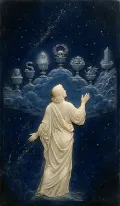 Seven of CupsShares: The crown knocked askew · The lapis tower · The heavy storm cloud
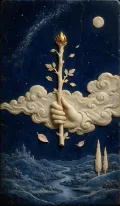 Ace of WandsShares: The scattered tongues of flame · The heavy storm cloud
 King of WandsShares: The scattered tongues of flame · The crown knocked askew