Minor Arcana · Swords
King of Swords
Tarot card meaning: upright, reversed and the symbols of the Olivia image
The King of Swords is clear judgement held with calm authority: thinking a matter through, deciding fairly and standing by reasons that can be explained.
- Upright
- clear judgementfairnessprincipled authorityintellectual clarityhonest counsel
- Reversed
- rigid thinkingcold detachmentauthority without reasonsharsh criticismsecond-guessing
Upright
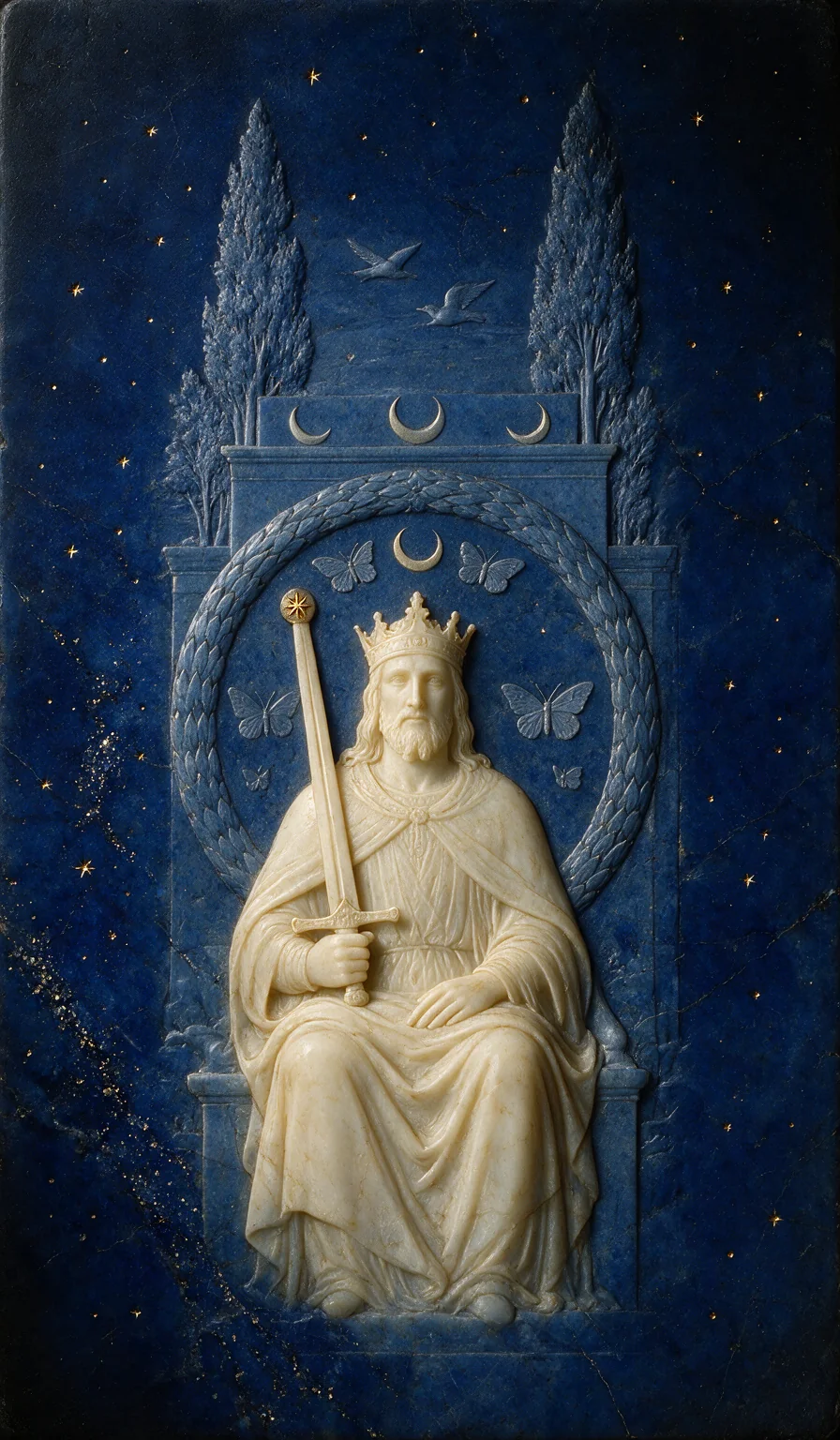
The King of Swords sits full-face on the throne and looks straight out of the card. Where the Queen of Swords sits in profile, this King faces you: among the Swords courts the Page observes, the Knight pursues, the Queen discerns, and the King decides. The sword is drawn and held firmly in one fist, while the other hand lies open and still on the robe. Upright, the card draws attention to thinking that has become a responsibility: weighing evidence, applying a standard fairly and taking ownership of a conclusion that affects others.
Look at the tip of the blade. Where a sword would normally narrow to a point, Olivia’s carving sets a gold eight-pointed star. It suggests that this King’s clarity is guided by something fixed, a principle or a stated standard, rather than by the wish to win the argument. The crescents on the throne and the butterflies within the wreath add a quieter note: good judgement also listens to intuition, and it has been shaped by change.
In a reading, the King of Swords can point to a decision you are ready to make, a boundary that needs a clear rationale, or the value of advice that is honest rather than comforting. It asks whether your reasoning could be followed by someone who disagrees, and whether the people who live with a decision have been considered in it.
Reversed
King of Swords reversed can show judgement that has hardened. A position may be defended because changing it feels like losing face, or authority may rest on status instead of on reasons anyone can examine. Clarity can turn into coldness, and precise words into criticism that leaves no room for reply.
The reversal can also turn inward: a mind that audits every choice until none can be made, or an inner judge harsher than any outside one. Return to the carving. The sword is held, not swung, and one hand rests open. Consider which decision needs its reasons written down, and where you could let new information change your view without treating that as defeat.
Read the image
Every element below is carved into this card. Scroll, hover or press a number to follow it on the image.
The drawn ivory sword
What you seeA long ivory blade rises from the King’s right fist, leaning slightly towards the viewer’s left; the crossguard has a raised, ornamented centre and rounded flared ends, and a small carved pommel shows beneath the fist.
What it carriesThe sword is the suit’s emblem of air: thought, speech, analysis and decision. The King holds it drawn but at rest, gripped rather than brandished, the way a judge holds an office. Its slight lean is worth noticing: a clear position, held without stiffness.
Follow this symbol through the deck ↗Gold star at the tip
What you seeWhere the blade would normally narrow to a point, it ends instead in a small round cap set with a gold eight-pointed star, the one gold accent on the ivory figure and its sword.
What it carriesA star replaces the blade’s point, so the sword leads with a fixed light rather than an edge. Stars in tarot suggest guidance and orientation, as in The Star. This is Olivia’s departure from the traditional image, and it reads as judgement steered by a principle, not by the wish to wound.
Follow this symbol through the deck ↗The ivory crown
What you seeThe King, seated full-face and looking straight out of the card, wears an open ivory crown of pointed, knobbed tips over long hair; its band is carved with small ornament and the tallest tip stands at the centre.
What it carriesThe crown marks the King as the suit’s outward ruler, responsible for decisions others live with. Carved in ivory rather than gold, it is made of the same material as the figure: authority that is part of the person, not a decoration. The frontal gaze, kept from the traditional image, meets you directly.
Follow this symbol through the deck ↗The hand at rest
What you seeThe King’s other hand lies on the lap near the knee, over the ivory robe, palm down with the fingers together and gently curved, while the sword hand stays closed around the grip beside it.
What it carriesOne hand holds the instrument of judgement; the other does nothing at all. The resting hand can be read as composure and restraint, the capacity to decide without acting on every passing thought. Together the two hands show a mind that is ready but not restless.
Follow this symbol through the deck ↗Six lapis butterflies
What you seeSix butterflies carved in pale grey-blue lapis are arranged in mirrored pairs inside the wreath: two beside the upper crescent, two larger ones level with the King’s head, and two small ones lower down.
What it carriesButterflies are carved on the traditional throne of this King and recur on the Queen’s: creatures of air, commonly read as the soul, breath and transformation. Set here in symmetrical pairs, they suggest a mind that has changed through experience and now holds those changes in order.
Follow this symbol through the deck ↗Four gold crescents
What you seeThree pale gold crescent moons are set along the top block of the throne, the central one largest; a fourth crescent hangs inside the wreath directly above the crown.
What it carriesCrescent moons also belong to the traditional throne of this King. The moon stands for reflection, cycles and what is not yet fully seen; placed above the head of the suit’s most deliberate figure, it suggests that clear thinking still rests on intuition, rest and the slower tides of feeling.
Follow this symbol through the deck ↗The leafy wreath
What you seeA wide ring of overlapping pointed leaves, carved in lapis in low relief, encircles the King’s head and upper body against the throne back, enclosing all six butterflies and the fourth crescent.
What it carriesThe wreath is Olivia’s addition. Leaf crowns have long honoured victory and recognised merit, and the ring frames the King like a seal or a medallion. It suggests authority that has been earned and conferred, a standing that depends on continuing to judge fairly.
Follow this symbol through the deck ↗Twin cypresses
What you seeTwo tall, narrow cypresses carved in lighter blue lapis rise behind the upper corners of the throne, each with a smaller tree beside it, framing the open sky above the crest.
What it carriesTrees shaken by wind recur through the suit of Swords as a picture of restless thought; here they are cypresses standing perfectly still. Evergreen and upright, cypresses are long associated with endurance and remembrance. Paired and symmetrical, they echo the King’s own balance.
Follow this symbol through the deck ↗Two birds in flight
What you seeBetween the cypresses, two birds carved in grey-blue lapis fly one behind and below the other, wings raised, in the open strip of night sky above the throne’s crescent-topped crest.
What it carriesBirds belong to air, and a pair of birds flies in the sky of the traditional King of Swords, where the Queen has one. Two together can suggest thought that has a companion: reasoning tested against another view, a free mind that still keeps formation.
Follow this symbol through the deck ↗
The number
Kings hold the outward mastery of their suit: the element used in the world, in service of others. In Swords, the suit of air, that mastery concerns thought, language and decision. The Page learns to observe, the Knight rushes to act on an idea, the Queen understands from within; the King brings all of this to bear on choices that affect other people. Here air becomes policy, principle and counsel: the mind made accountable.
The tradition
In the Golden Dawn system the court ran King, Queen, Prince and Princess, and the King of the 1909 Waite and Smith deck is usually matched with the Golden Dawn Prince of Swords, “Prince of the Chariots of the Winds”: Air of Air, the element in its purest form. Its zodiac span runs from 20° Capricorn to 20° Aquarius, covering the decans of the Four of Pentacles, Five of Swords and Six of Swords. Some readers instead link the card to the Golden Dawn King, “Lord of the Winds and Breezes”, Fire of Air. In the guide that accompanied that deck, Waite compared this seated figure with Justice among the Major Arcana, and Pamela Colman Smith drew the King facing straight out.
As a temperament
- Temperament
- As a temperament, the King of Swords is analytical, composed and fair-minded. This way of acting gathers the facts, separates them from opinion, and reaches a conclusion that can be stated plainly and defended with reasons. It is comfortable with responsibility, and with the loneliness that sometimes comes from making the call others would rather avoid.
- Gifts
- Its gifts are impartial judgement, clear policy and honest counsel: the ability to shape a rule that is fair to everyone, to explain a hard decision without cruelty, and to advise from principle rather than from mood. Like the star on the blade, this King offers a fixed point others can orient by.
- Shadow
- In shadow, reason becomes a fortress. You might rank logic above every feeling, treat disagreement as disloyalty, or hold a verdict long after the evidence has moved. Judgement can turn into a habit of judging people. The carving offers a counterweight: the sword is held still, and the other hand rests open.
Love, work and self
- Love
- In love and close relationships, the King of Swords asks for fairness and clear communication. It can point to a conversation where you state your reasons instead of hinting, or to an agreement that would benefit from being spelled out. It also asks whether you stay reachable while being reasonable: a well-argued position can still leave the other person unheard. With yourself, it invites an inner voice that assesses your choices fairly, not harshly.
- Work
- At work, in study and with money matters, this card favours structured thinking: setting criteria before choosing, recording why a decision was made, and reviewing the evidence rather than the loudest opinion. It can point to roles that carry judgement, such as editor, assessor, mediator or team lead. Consider one decision in front of you and write down the standard you are applying; if you would not defend it openly, it may need rethinking.
- Self
- For your own life, the King of Swords turns attention to how you exercise authority over your own mind. Like the King sitting still with the sword drawn and the other hand at rest, you might practise holding a conclusion without gripping it. Notice which of your principles work like the star on the blade, steady points that orient you, and which have become rules you follow out of habit or fear of being wrong.
In a spread
Read the card through each position before you look at Olivia’s version. A position is a question, and the same card answers each one differently.
The situation
What aspect of the situation deserves attention?
Olivia’s readingAt the heart of a question, this card suggests the matter turns on a clear, fair decision: naming the standard, weighing the evidence and taking responsibility for the conclusion.
What complicates it
What tension or assumption deserves a closer look?
Olivia’s readingAs a challenge, it can show judgement grown rigid or remote, a need to be right that crowds out listening, or authority that explains itself too little.
A helpful next step
What small action could help you understand or respond?
Olivia’s readingAs advice, it invites you to decide on stated grounds: write down your reasons, check them against the facts, and share them with the people the decision affects.
In conversation with
- King of Swords + Justice
With Justice, the drawn sword appears on two thrones, and Waite linked the cards directly. Together they draw attention to fairness as a practice: a standard applied consistently, and consequences weighed for everyone involved, including the one who judges.
- King of Swords + Queen of Swords
With the Queen of Swords, butterflies on both thrones and birds in both skies join the cards: one bird for the Queen, two for the King. One sits in profile, one faces you; together they ask whether you need inward discernment or an outward decision.
- King of Swords + Ace of Swords
With the Ace of Swords, the gold crown circling the Ace’s blade returns in ivory on the head of the one who holds the sword. The Ace brings a new idea or insight; the King asks how to govern it and use it responsibly over time.
Questions to keep
- What would someone who disagrees with you need in order to follow the reasoning behind your decision?
- What fixed principle, like the star at the tip of the blade, is guiding your judgement here?
- Where are you holding a position out of habit or pride rather than because the evidence supports it?
Ask them with three cards ↗A three-card reading in which each position asks one of these questions.
A small practice
Before one decision this week, write the standard you are using in a single sentence, then check your choice against it before you act.
Cards that share its symbols
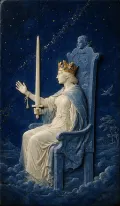 Queen of SwordsShares: The drawn ivory sword · The ivory crown · The hand at rest · Six lapis butterflies · Two birds in flight
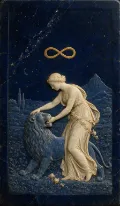 StrengthShares: Four gold crescents · Twin cypresses · The hand at rest
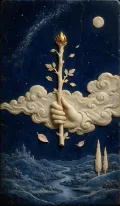 Ace of WandsShares: The hand at rest · Four gold crescents · Twin cypresses
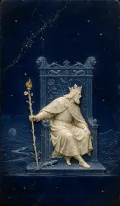 King of WandsShares: Two birds in flight · The ivory crown · Four gold crescents