Minor Arcana · Pentacles
Queen of Pentacles
Tarot card meaning: upright, reversed and the symbols of the Olivia image
The Queen of Pentacles is practical care made visible: tending body, home, work and resources steadily, so that what you look after can keep growing.
- Upright
- practical carenourishmentresourcefulnesssteady abundancehospitalitygrounded presence
- Reversed
- overgivingself-neglectsmotheringscarcity worryneglected basics
Upright
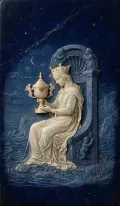
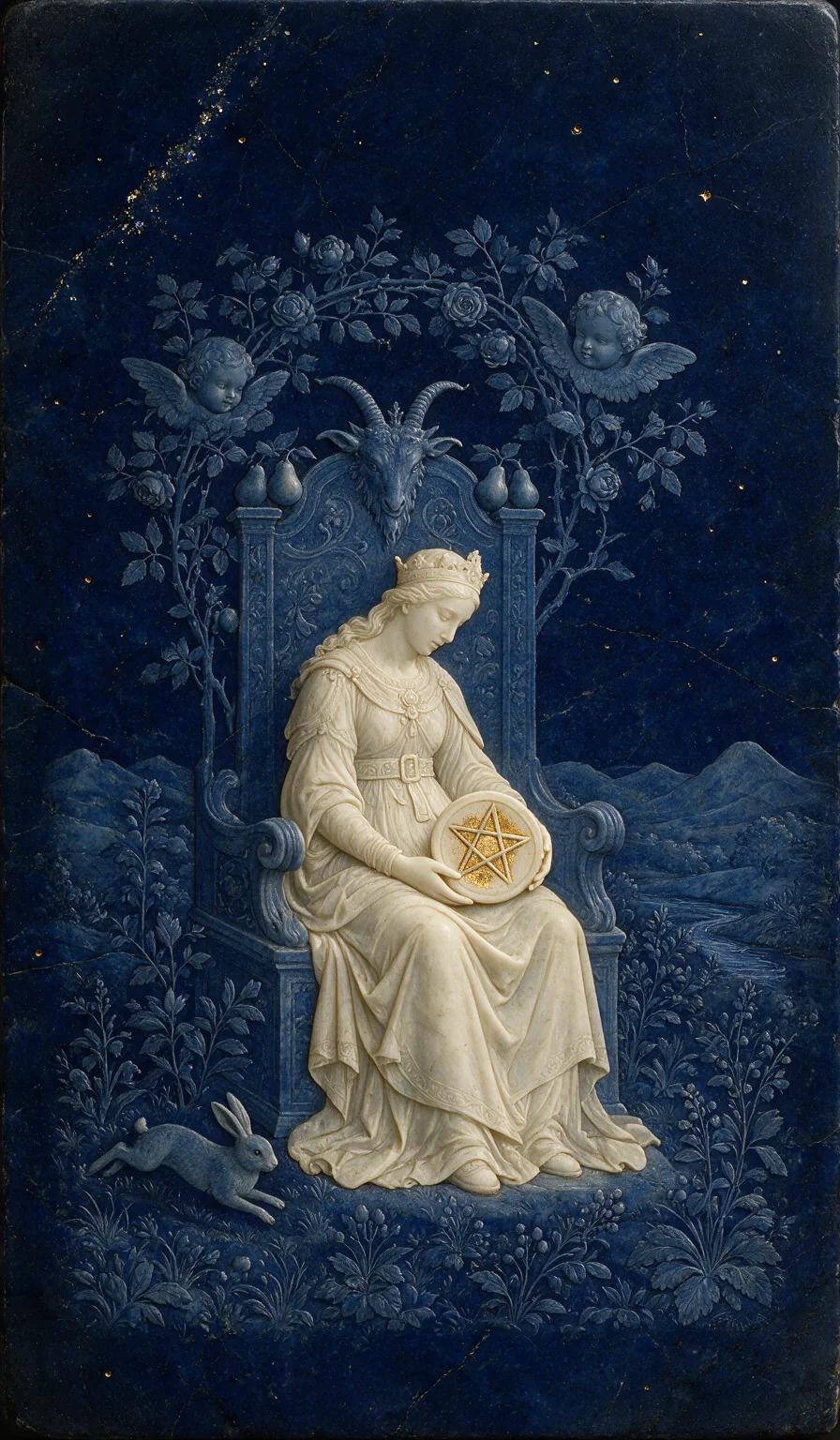
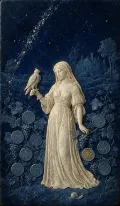
The Queen of Pentacles draws attention to care you can touch: a meal, a mended routine, a budget that actually fits, a room that makes rest possible. In Olivia’s image the pentacle is not held up for show. It is cradled low in the lap with both hands, and the Queen’s eyes rest on it the way you might watch bread rise or check a seedling you planted. The gold is on the disc and nowhere else on the figure; even the crown is plain ivory. Authority here is attention.
Everything around the throne grows. Roses arch overhead, pears sit ripe on the posts, berries crowd the ground and a river feeds the valley behind. None of this arrived at once. The card honours the slow kind of abundance that comes from tending: watering, pruning, noticing what needs doing before it becomes urgent.
Upright, the Queen asks you to bring that quality to your own question. What is the most practical, kind thing you could do here? Often it is small: preparing something ahead, making a space more comfortable, writing a number on paper instead of carrying it as worry. The care includes the one who gives it. The rabbit leaping towards the ivory hem is a reminder that life gathers where things feel nourished and safe.
Reversed
Queen of Pentacles reversed can point to care that has tipped out of balance. Provision may have become constant, leaving little for the person doing the providing, or concern for comfort and security may crowd out the people it was meant to serve. It can also turn inward as worry about resources: a sense that nothing is quite enough, however much is tended.
Look at the image again: the disc rests in the lap, supported from beneath rather than gripped. Reversed, the invitation is to loosen a hold that has become anxious, or to pick up basics that have slid: sleep, food, a bill, one tidy corner. Ask what could be simplified, shared or allowed to be good enough, and whether your own needs are on the list.
Read the image
Every element below is carved into this card. Scroll, hover or press a number to follow it on the image.
The rose arbour
What you seeA lapis rose vine climbs from both sides of the throne and meets in an arch above it, carved with open roses, tight buds and serrated leaves in paler blue relief against the starred night.
What it carriesRoses in the suit of Pentacles speak of cultivated beauty: something grown, pruned and tended over seasons rather than bought. The arbour frames the Queen as the keeper of a garden, so the care this card describes reads as ongoing work, not a single gift.
Follow this symbol through the deck ↗Two winged cherubs
What you seeTwo cherub heads with small feathered wings nestle in the rose vine, one on each side of the arch; the left one looks down, the right one turns its round face out towards the viewer.
What it carriesIn Pamela Colman Smith’s design, cherubs are carved into the throne itself, a sign of love and innocence held within material comfort. Here they have moved up into the living roses, so tenderness sits inside the growing world, not only in its furniture.
Follow this symbol through the deck ↗The goat’s head crest
What you seeA lapis goat’s head with ridged, backward-curving horns and a short beard crowns the top of the throne back, midway between the two pear-topped posts and just above the Queen’s crown.
What it carriesThe goat is Capricorn’s animal, the sign where most of this Queen’s zodiac span lies, and it stands for patient, sure-footed climbing. Pamela Colman Smith’s 1909 card carves a goat’s head on the throne’s arm; Olivia lifts it to the top of the throne, where it reads almost as a crest.
Pears on the throne posts
What you seeTwo plump carved pears sit on top of each throne post, four in all, their stalks upright; the posts beneath them are cut with fine scrollwork in the same greyed lapis as the throne.
What it carriesFruit carved on the 1909 throne points to ripeness and harvest: resources that come from patient growing. Set at the top of the posts like finials, the pears make abundance part of the structure that holds the Queen up, not an ornament added afterwards.
Follow this symbol through the deck ↗Ivory crown, lowered gaze
What you seeThe Queen wears a low ivory crown with small points over long wavy hair drawn forward over one shoulder; the head tilts down and the eyes rest on the disc in the lap.
What it carriesWaite described this Queen as contemplating the suit’s symbol, and Olivia keeps that downward look: attention rather than display. The crown stays ivory, not gold; the one gold object is the disc being tended, so authority here rests in the quality of attention given to it.
Follow this symbol through the deck ↗The gold pentacle
What you seeAn ivory disc rests in the Queen’s lap, cradled by both hands, one beneath it and one at its edge; a gold five-pointed star of interlaced lines is inlaid on it, its field flecked with gold.
What it carriesThe pentacle is the suit’s emblem of earth: body, home, money, time and skill made tangible. Held low and close to the body, it is tended like bread rising rather than displayed. It is the only gold on the figure, and the brightest gold on the card.
Follow this symbol through the deck ↗River through the valley
What you seeBeyond the right arm of the throne a river winds out of a valley between wooded slopes, below a peaked mountain; more hills rise on the left behind the throne, all carved in soft lapis.
What it carriesWater flowing through earth echoes this Queen’s Golden Dawn attribution, Water of Earth: feeling that moistens and feeds practical life. The river keeps the valley green, a quiet picture of how steady care, not force, makes land yield.
Follow this symbol through the deck ↗The leaping rabbit
What you seeA grey-blue rabbit carved in lapis stretches in mid-leap across the grass at the lower left, ears raised, facing the ivory hem of the Queen’s gown.
What it carriesThe rabbit is a traditional image of fertility and quick, abundant life. Pamela Colman Smith put it in the lower right corner; Olivia moves it to the left and sets it running towards the Queen, so the small, lively creature approaches the Queen rather than lingering in the margin.
Berry plants underfoot
What you seeThe ground around the throne is dense with carved foliage: broad-leaved plants and stems heavy with round berries fill the foreground on both sides of the ivory hem and the two shoe tips.
What it carriesThe Queen sits in growth, not on bare ground. The lap holds the emblem and the soil holds the harvest; the berries repeat the pears above, so abundance runs from the top of the throne down to the tended earth.
Follow this symbol through the deck ↗
The number
Queens are the inward mastery of their suit: they hold its element as a way of being rather than a task to pursue. In Pentacles, the suit of earth, that means knowing materials, bodies, money and time from the inside. After the Page’s careful study and the Knight’s slow, patient labour, the Queen receives what has grown and keeps it alive. This mastery shows as fit: the right amount, at the right moment, for real needs.
The tradition
In the Golden Dawn system this card is titled the Queen of the Thrones of Earth, Water of Earth: the receptive, nourishing side of the element. Its zodiac span runs from 20° Sagittarius to 20° Capricorn, covering the decans of the Ten of Wands, Two of Pentacles and Three of Pentacles, which helps explain the goat, Capricorn’s animal, in its imagery; Book T gives this Queen a winged goat’s head as a crest. Older Italian and Marseille decks show a crowned Queen of Coins holding a single coin. Pamela Colman Smith’s 1909 design set the Queen beneath a bower of roses, with a rabbit in the lower corner and a fertile landscape beyond.
As a temperament
- Temperament
- As a temperament, the Queen of Pentacles is calm, observant and hands-on. This way of being notices the physical conditions of a situation first: whether people have eaten, whether the chair is comfortable, whether the plan fits the budget and the hours available. Its patience is practical, trusting what grows at its own pace and tending it daily.
- Gifts
- The gifts here are resourcefulness and hospitality: making much from little, turning a house into a place where people can rest, keeping accounts that let everyone breathe. This Queen is at ease with bodies, plants, food, materials and routines, and helps others feel physically safe without making a fuss about it.
- Shadow
- In shadow, care becomes control or depletion. You may give until your own reserves run dry, measure love by provision, or smother others with comfort they did not ask for. Worry about security can harden into holding on too tightly. The image offers a counterweight: gold cradled in the lap, not clutched.
Love, work and self
- Love
- In love and close relationships, the Queen of Pentacles speaks the language of practical care: a warm meal, a remembered appointment, a home that feels good to come back to. It invites you to notice how affection is shown in deeds as well as words, and to ask whether that care flows both ways. With yourself, it can mean treating your body and your rest as worth tending, not only as tools for looking after others.
- Work
- At work, in study and with money, this card favours steady stewardship over dramatic moves. It can point to a project that needs tending rather than reinventing, or to the value of well-kept records, a realistic schedule and a workspace that supports you. Consider where small, regular attention would make resources go further, and where your practical skill is quietly holding things together and deserves to be named.
- Self
- For your own life, the Queen of Pentacles turns attention to the body and the everyday: sleep, food, movement, the state of the room you wake up in. Like the Queen looking down at the disc, you might look closely at one ordinary thing you already have and ask how to care for it well. Self-worth here is grounded and quiet, built from how you treat your own time and hands.
In a spread
Read the card through each position before you look at Olivia’s version. A position is a question, and the same card answers each one differently.
The situation
What aspect of the situation deserves attention?
Olivia’s readingAt the heart of a question, this card suggests the matter is about sustaining something real: a household, a body, a project or a relationship that needs regular, practical attention more than a big decision.
What complicates it
What tension or assumption deserves a closer look?
Olivia’s readingAs a challenge, it can show care stretched too thin, or comfort and security taking up so much room that there is no space left for change, rest, or other people’s own way of doing things.
A helpful next step
What small action could help you understand or respond?
Olivia’s readingAs advice, it invites one practical act of care today, for someone else and for yourself: prepare, tidy, nourish or budget, and let that small act count as enough.
In conversation with
- Queen of Pentacles + The Empress
With The Empress, the theme of nurture doubles. The Empress is abundance as a force of nature; the Queen of Pentacles is the one who harvests, stores and serves it. Together they ask how growth becomes everyday nourishment.
- Queen of Pentacles + The Devil
The Devil shares this Queen’s goat and Capricorn’s earth. Side by side they draw attention to your relationship with material things: held with care and generosity, or gripped from fear and habit. Which one describes the pentacle in your lap?
- Queen of Pentacles + Nine of Pentacles
The Nine of Pentacles is the suit’s picture of self-sufficiency and cultivated ease. With the Queen, the pair balances enjoying your own resources and sharing them: tending your garden well enough that others can rest in it too.
Questions to keep
- What in your life is asking to be tended regularly rather than fixed once?
- Where are you giving care in a way that no longer includes you?
- Which practical comfort would make the coming week easier for you or someone close?
Ask them with three cards ↗A three-card reading in which each position asks one of these questions.
A small practice
Choose one ordinary object you use daily, such as a cup, a pan or a notebook, and clean, mend or arrange it with full attention, noticing how care changes it.