Minor Arcana · Pentacles
Nine of Pentacles
Tarot card meaning: upright, reversed and the symbols of the Olivia image
The Nine of Pentacles pictures self-sufficiency that has ripened into pleasure: a life tended patiently enough that you can now stand in it and enjoy it.
- Upright
- self-sufficiencycultivated comfortrefined pleasuredisciplineindependenceearned leisure
- Reversed
- isolationoverworkcomfort on displaydependencejoyless achievement
Upright
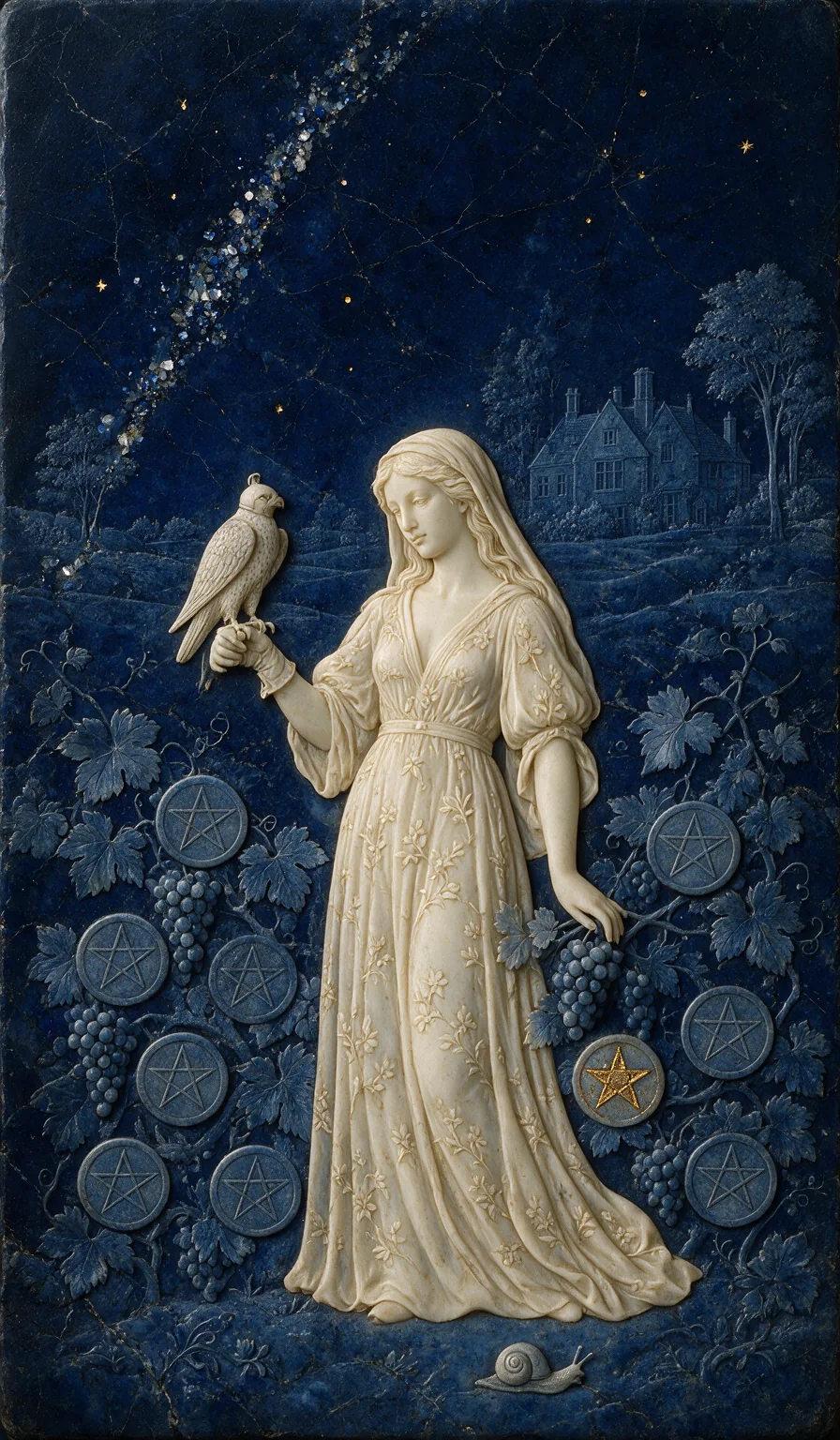
The Nine of Pentacles is the card of a garden that has come into its own. After the planting, the craft and the waiting of the earlier Pentacles, it draws attention to the moment when what you have tended can hold you in return. In Olivia’s deck the ivory figure stands alone in a vineyard at night, grapes heavy on every side, a manor house far off among the trees and the Milky Way crossing the sky. There is no crowd and no audience, and nothing in the scene looks lacking.
Look at the two hands. The raised one wears a gauntlet and carries a hooded falcon, a wild creature trained to patience; the other is bare and rests lightly on the vine above the grapes, while the bowed head looks at neither. Discipline and enjoyment each have a hand. Among the vines, nine discs are carved in the same blue stone as the leaves, almost part of the garden, and a tenth shines in gold just below the resting hand, as though value becomes visible once it is noticed.
Upright, the card invites you to recognise what you have built, whether a skill, a home, a routine or steadier footing, and to let yourself live in it rather than immediately planning the next harvest. Independence here is not coldness: it is enough ease in your own company that being with others becomes a choice.
Reversed
Nine of Pentacles reversed draws attention to self-sufficiency that has tipped out of balance. It can point to independence that has hardened into isolation, a garden kept so carefully that no one is invited in, or to comfort that never quite arrives because there is always one more task to finish first. It can also show the opposite pull: a sense of security that rests on someone else’s approval or support, so that your own ground feels thin.
Sometimes the falcon has slipped its hood: restlessness where calm discipline used to be, or pleasure kept up for display rather than felt. The card asks what would let you step back into your own garden, even briefly, and enjoy one thing already made without earning it again.
Read the image
Every element below is carved into this card. Scroll, hover or press a number to follow it on the image.
The hooded falcon
What you seeAn ivory falcon perches on the raised hand at left, talons gripping a fitted glove with a flared cuff. A small hood with a loop on top covers its head; its long tail hangs down beside the wrist.
What it carriesThe hooded falcon is the card’s best-known emblem: a wild, swift creature trained to wait and to return. It is commonly read as discipline turned into freedom, instinct brought under calm control. The figure’s eyes are lowered elsewhere; the bird no longer needs watching.
Follow this symbol through the deck ↗The bare hand on the grapes
What you seeThe other hand hangs ungloved at right, fingertips resting lightly on the vine stem just above a heavy cluster of grapes. The veiled head is bowed, eyes lowered, looking at neither bird nor fruit.
What it carriesGrapes are the classic Pentacles sign of harvest and slow-ripened pleasure: wine takes seasons. One hand is gloved for discipline, the other bare for enjoyment. The touch is light; the figure is not picking or counting, only appreciating what has grown.
Follow this symbol through the deck ↗Nine grey-blue discs
What you seeCounted disc by disc, nine grey-blue lapis pentacles with incised five-pointed stars sit among the vine leaves: six stacked beside the gown at left, three spaced down the right edge.
What it carriesThe traditional card shows nine pentacles growing among the vines, wealth that has become part of the landscape. Here they are carved from the same blue stone as the leaves, almost camouflaged. Resources at this stage are not piled up or displayed; they have been grown into a life.
Follow this symbol through the deck ↗A tenth disc in gold
What you seeJust below the grape cluster at right, one further disc carries a five-pointed star inlaid in gold, the only gilded pentacle on the card. With it, the discs number ten.
What it carriesThe traditional card counts nine pentacles. Olivia adds a tenth and gilds it, close to the resting hand. You may read it as the worth that enjoyment adds: the same wealth, noticed. It can also hint at the Ten of Pentacles ahead, where a private garden becomes a shared inheritance.
Follow this symbol through the deck ↗The flowered ivory gown
What you seeThe figure wears a long ivory gown with a deep V neck, a sash at the high waist and full elbow-length sleeves, carved all over with small flower sprays; a veil drapes over the head, long hair falling beneath it.
What it carriesThe traditional robe is also patterned with flowers, in which some readers see the glyph of Venus, the planet assigned to this card. Here the blossoms are carved into the ivory itself, as if the garden has grown into the clothing: refinement that has become second nature.
The manor among trees
What you seeFar off at upper right, a gabled manor house with tall chimneys and mullioned windows is carved in pale blue lapis, sheltered by tall trees on softly rolling ground.
What it carriesA house in the distance belongs to the traditional card: the estate the garden is part of. It suggests security that has been built and can be returned to, yet the figure has chosen to stand out among the vines. Comfort is the base here, not the destination.
Follow this symbol through the deck ↗The glittering Milky Way
What you seeA broad diagonal band of crushed, sparkling fragments, silver and pale blue, runs from the top centre down towards the left horizon, among scattered gold star flecks in the dark lapis sky.
What it carriesThe traditional Nine of Pentacles is set in golden daylight. Olivia moves the garden into a clear night with the Milky Way arching over it. Solitude here feels spacious rather than lonely: the figure stands alone, but under a sky full of company, at ease in a quiet hour.
Follow this symbol through the deck ↗The small snail
What you seeOn the bare ground just below the hem, a small snail with a spiralled shell is carved in pale grey stone, horns raised, moving towards the right.
What it carriesThe traditional card also sets a snail in the foreground. It is commonly read as patience and self-containment: a creature that carries its home and moves at its own pace. It recalls that this abundance was built slowly, and that the slowness was part of the craft.
The number
Nine is the last single number before the Ten completes the cycle and hands it on; it is a suit’s fullness held by one person. In Pentacles, the suit of Earth, body, craft, resources and daily care, that fullness is self-sufficiency: the patient work of the Eight has become a way of life. The Nine asks you to notice that enough has been reached, and to enjoy it for its own sake before the Ten turns private ease into something shared, inherited or passed on.
The tradition
In the Golden Dawn system the Nine of Pentacles, there called the Nine of Disks, is titled the Lord of Material Gain. It is assigned to Venus in Virgo, the second decan of that sign (10 to 20 degrees), and to Yesod, the Foundation, the ninth Sephirah, here expressed in the world of Earth. Venus brings pleasure and beauty, careful Virgo brings refinement and method, so the pairing is often read as enjoyment earned through diligence. Aleister Crowley shortened the title to Gain. Marseille decks show nine coins set among stylised flowering stems. Pamela Colman Smith’s 1909 design gave it the familiar scene: a figure alone in a vineyard of pentacles, a hooded bird on a gloved hand, a distant house and a snail.
Love, work and self
- Love
- In close relationships the Nine of Pentacles turns attention to what you bring as a whole person rather than as someone waiting to be completed. The figure stands alone in the garden by choice, and that ease can make closeness freer: you can share a life without handing over its care. The card may also ask how you treat your relationship with yourself, and whether you offer yourself the patience and pleasure you would offer someone you love.
- Work
- At work, in study or in money matters, the card can reflect a point where effort has become competence: skills that no longer strain, routines that run, resources built with care. It invites you to notice this and let it support a little more freedom, in time, choice or quality of life. This is not guidance on spending or investing; it is a prompt to recognise the ground you have already made under your own feet.
- Self
- For your relationship with yourself, this card asks whether you can enjoy what you have tended without having to justify it. The gloved hand and the bare hand suggest both are needed: self-discipline that holds steady, and a willingness to reach for the grapes. Notice where you feel most at home in your own company, and whether comfort has room in your days or keeps being postponed until the next milestone.
In a spread
Read the card through each position before you look at Olivia’s version. A position is a question, and the same card answers each one differently.
The situation
What aspect of the situation deserves attention?
Olivia’s readingAt the centre of a question, the Nine of Pentacles can point to something you have patiently built that may be ready to be lived in and enjoyed, not only maintained or improved.
What complicates it
What tension or assumption deserves a closer look?
Olivia’s readingAs a challenge, the card can show self-reliance that has become a wall, or comfort you never let yourself feel because the next harvest always seems to come first.
A helpful next step
What small action could help you understand or respond?
Olivia’s readingAs advice, it invites you to pause, recognise what is already yours, and enjoy one part of it deliberately, the way the bare hand rests on the grapes.
In conversation with
- Nine of Pentacles + The Empress
The Empress, assigned to Venus in the Golden Dawn system, is traditionally set in a fertile landscape of trees and ripening wheat. The Nine of Pentacles shows that abundance held by one person in a cultivated space; together they ask how pleasure and nurture can grow from your own care.
- Nine of Pentacles + Five of Pentacles
The Five of Pentacles traditionally shows figures outside in the cold; the Nine shows a figure at ease within the garden. Together they draw attention to how security and belonging are built, and to how the one inside might open a gate for others.
- Nine of Pentacles + Ten of Pentacles
The Ten of Pentacles is the next step: in the traditional image the private garden becomes a household of several generations gathered at the threshold of home. Together the pair asks what you have built for yourself, and what of it you would like to share or pass on.
Also read withNine of CupsQueen of PentaclesAll pairs ↗
Questions to keep
- What have you tended long enough that it could now hold you in return?
- Which part of your independence feels like freedom, and which part feels like managing alone?
- What would it look like to enjoy something you have made without first earning it again?
Ask them with three cards ↗A three-card reading in which each position asks one of these questions.
A small practice
Choose one thing you have built or cared for, a plant, a skill or a room, and spend ten unhurried minutes simply enjoying it without improving anything.
Cards that share its symbols
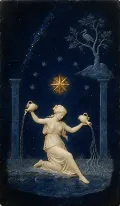 The StarShares: The glittering Milky Way · The hooded falcon · The flowered ivory gown
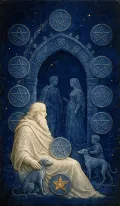 Ten of PentaclesShares: Nine grey-blue discs · The glittering Milky Way · The flowered ivory gown
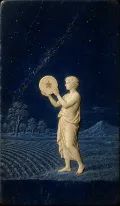 Page of PentaclesShares: The glittering Milky Way · Nine grey-blue discs · The flowered ivory gown
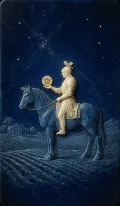 Knight of PentaclesShares: Nine grey-blue discs · The manor among trees · The glittering Milky Way