Minor Arcana · Wands
Ace of Wands
Tarot card meaning: upright, reversed and the symbols of the Olivia image
The Ace of Wands is the first spark of desire and creative will: an idea or impulse offered to you, asking to be taken up and given room to grow.
- Upright
- sparkcreative impulsefresh enthusiasmnew ventureraw potentialcourage to begin
- Reversed
- scattered energystalled startwaning interestimpatienceuntested ideas
Upright
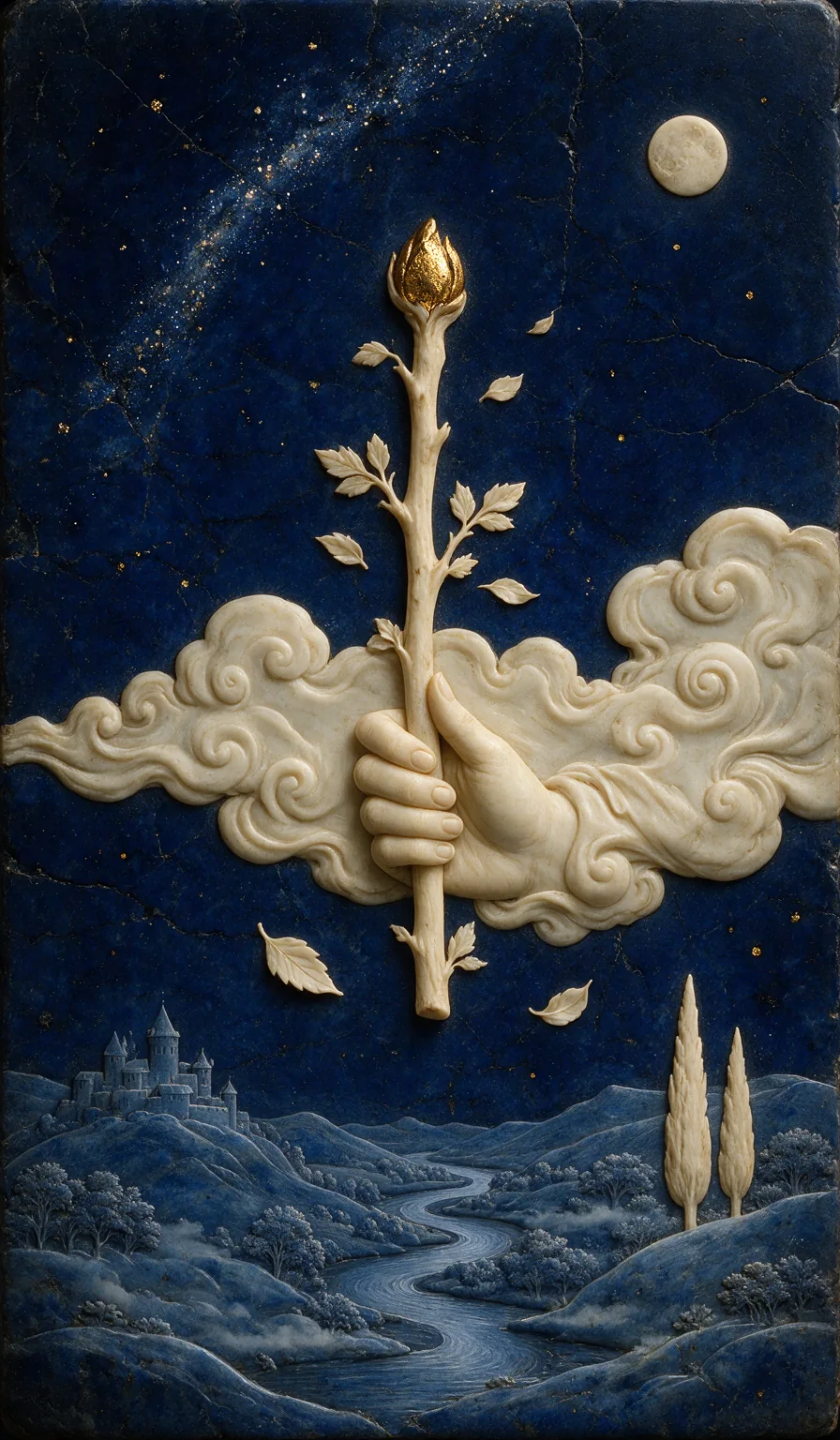
The Ace of Wands draws attention to the moment something catches: an idea you cannot stop thinking about, a sudden wish to make, try or begin. Wands are the suit of Fire, of desire, will and creative energy, and the Ace is that fire before it has a direction. In Olivia’s card the whole charge sits in one place, a closed bud of gold at the tip of an ivory staff, shaped like a flame that has not yet opened. Nothing has been built. What is offered is potential, warm and a little urgent.
The staff is held out from a cloud by a single hand, firm and close, as if waiting for you to take hold. That is the card’s quiet question: will you grasp it? The wood is alive, sprouting small sprigs of leaves, and six more leaves drift loose around it; this spark is generous, more than any one plan could use. Far below, a castle stands on its hill and a river winds through the night towards you, the long road a beginning could travel.
Upright, the card invites you to trust your enthusiasm enough to act on it in a small, real way. A first sketch, a first conversation, one hour of practice: give the fire something to burn. Then notice what happens to your interest once your hands are involved.
Reversed
Ace of Wands reversed points to a spark that has not yet found somewhere to land. The closed bud stays shut: an idea you keep circling without trying, excitement that jumps from one plan to the next, or a dip in energy that makes a good beginning feel out of reach. It can also show fire turned inward, a creative urge kept private because it feels too new or too fragile to show.
Here the card asks what the spark needs now. Sometimes it is rest or a better moment; sometimes it is a much smaller first step than the one you imagined. A dip in enthusiasm is not proof that an idea lacks value. Choose one idea, give it one concrete task, and notice whether the warmth returns.
Read the image
Every element below is carved into this card. Scroll, hover or press a number to follow it on the image.
The gold flame-bud
What you seeAt the top of the staff sits a closed bud of gold, its pointed petals rising together like a single flame, cupped in ivory sepals. It is the only gilded part of the carving.
What it carriesWands belong to Fire, and the traditional Ace is often surrounded by sparks or flame-like leaves. Olivia gathers that fire into one golden bud that has not yet opened: energy concentrated at the very tip, still held in, ready to become flower or flame.
Follow this symbol through the deck ↗The living staff
What you seeA straight ivory staff, knotted like a cut branch and blunt at its lower end, rises from the hand to the bud; small sprigs of serrated leaves grow from it above and below the fist.
What it carriesIn decks that follow Pamela Colman Smith’s design the wands of this suit are living wood that still sprouts, commonly read as will, desire and creative force. Fresh shoots on a cut stick say the impulse is organic: it grows when tended, not when forced.
Follow this symbol through the deck ↗The hand from the cloud
What you seeAn ivory hand reaches in from the right, its wrist lost in the cloud’s curls. Four fingers wrap the staff with their nails turned towards you, and the thumb presses upward along its right side.
What it carriesIn decks that follow Pamela Colman Smith’s design each Ace shows a hand offered from a cloud: a gift that arrives before you have planned or earned it. Here the grip is firm and close, the thumb braced, as if the staff is being held out for you to take hold.
Follow this symbol through the deck ↗Spiralling ivory cloud
What you seeA broad ivory cloud crosses the card from the left edge to the right, its surface carved into tight spirals and scrolls; it billows highest on the right, where the hand emerges.
What it carriesThe cloud marks the source as unseen: the spark comes from beyond what you can plan or explain. Its whirling spirals, carved like wind or smoke, bring a sense of stirring energy into an otherwise still and upright image.
Follow this symbol through the deck ↗Six falling leaves
What you seeSix loose ivory leaves drift in the lapis around the staff, four above the cloud and two below it, each turned at a different angle as if just shaken free.
What it carriesThe traditional Ace of Wands sheds leaves from its rod, and they are commonly read as Yods, the small flame-shaped Hebrew letter linked with the first spark of creation. Here they fall freely: energy overflowing its source, more than one idea could use.
Follow this symbol through the deck ↗Full moon and Milky Way
What you seeIn the upper right hangs a round ivory full moon with faint craters, while a glittering band of pale mineral and gold flecks crosses the sky from the top edge down towards the left.
What it carriesThe traditional card has no night sky; Olivia sets it at night. Fire here is the first light in darkness, the idea that comes when everything else is quiet, lit by moon and stars rather than by the sun.
Follow this symbol through the deck ↗Castle on the hill
What you seeFar off on the left, a castle of pointed towers and turrets crowns a hill, carved in pale grey-blue lapis in the same low relief as the hills and trees around it.
What it carriesA castle on a distant hill belongs to the traditional image too, often read as the goal: the lasting structure a spark could one day build. It stays small and far away, because the Ace holds the beginning, not the finished stronghold.
Follow this symbol through the deck ↗The winding river
What you seeA silver-blue river curls in wide bends from the far hills down to the bottom edge of the card, between wooded slopes and low banks of mist carved in lapis.
What it carriesRivers in tarot often carry the flow of feeling and time. Beneath a card of pure Fire, the water suggests that a new spark needs a course to follow: energy that finds a channel travels far, energy without one scatters.
Follow this symbol through the deck ↗Two ivory cypresses
What you seeOn the right-hand hill stand two slim cypresses carved in ivory, the left one taller, their pointed crowns reaching upward. They are the only trees on the card not carved in lapis.
What it carriesSlim cypresses are not part of the traditional image. Evergreen and flame-shaped, they echo the staff and its bud down in the landscape: a reminder that fire can also take the form of steady, upright growth that lasts through the seasons.
Follow this symbol through the deck ↗
The number
The Ace is the one of its suit: the root and seed, the single point before anything divides. In Wands, the suit of Fire, that seed is raw will and creative heat, the urge to begin, to move, to make. The rest of the suit unfolds from it, through the planning of the Two and the widening horizons of the Three to the heavy load of the Ten. The Ace asks only that the spark be noticed and held, not yet directed or proved.
The tradition
In the Golden Dawn system the Ace of Wands is titled the Root of the Powers of Fire. The Aces were given no decans: each stands for its element in Kether, the crown of the Tree of Life, and the order’s Book T set them around the north pole of the heavens, each ruling a quarter of the sky. Book T describes a radiant hand from clouds grasping a heavy club, surrounded by leaping flames, or Yods. Pamela Colman Smith’s 1909 card turned the club into a sprouting branch shedding leaves. Marseille decks show a hand from a cloud gripping a rough, knotted club. Some modern readers link this Ace to the three fire signs, Aries, Leo and Sagittarius.
Love, work and self
- Love
- In close relationships the Ace of Wands can point to fresh warmth: attraction, playfulness, the wish to do something new together. It does not tell you what another person feels. It asks where your own spark is, and whether you let it show. In a long relationship it may invite one unfamiliar shared adventure, however small. With yourself, it asks you to take your own desires seriously enough to act on one of them.
- Work
- At work or in study, this card often turns attention to a new project, an idea for a course or creative piece, or a sudden appetite to learn a skill. The staff is still a cut branch with a closed bud: the idea is real but untested. Give it a small, concrete trial before a grand plan, and notice what support it would need. Where money is involved, a sober conversation with someone qualified can help the fire find a safe hearth.
- Self
- For your relationship with yourself, the Ace of Wands asks where your energy is quietly gathering. The bud is closed, but it is gold: something in you is ready and valuable before it is visible. Notice what makes you lean forward, what you think about when no one asks you to. Treat that interest as information about what you care for, and protect a little time for it, the way a hand shields a flame.
In a spread
Read the card through each position before you look at Olivia’s version. A position is a question, and the same card answers each one differently.
The situation
What aspect of the situation deserves attention?
Olivia’s readingAt the centre of a question, the Ace of Wands can point to a new impulse or desire that may lie beneath everything else. The real matter may be whether you want to take hold of it.
What complicates it
What tension or assumption deserves a closer look?
Olivia’s readingAs a challenge, the card can show enthusiasm outrunning follow-through: many sparks and no hearth, or a strong urge to begin that turns to impatience when first results are slow.
A helpful next step
What small action could help you understand or respond?
Olivia’s readingAs advice, it invites you to take the offered staff: choose the idea with the most warmth in it and give it one small, real action this week.
In conversation with
- Ace of Wands + The Magician
The Magician raises a wand with intention; the Ace offers one from a cloud. Together they draw attention to the step from raw inspiration to skilled, focused use, and ask what tools you already hold for this new idea.
- Ace of Wands + Two of Wands
With the Two of Wands the pair traces a sequence: first the spark, then the plan. Together they ask how an exciting beginning becomes a direction, and what wider view would help you choose where to take it.
- Ace of Wands + Ace of Cups
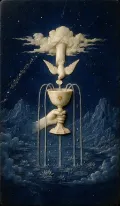
In Smith’s design both Aces offer a gift from a cloud; in Olivia’s deck the two hands reach in from opposite sides. The Ace of Cups brings a new feeling, this Ace a new drive; together they ask whether what excites you also moves your heart.
Also read withTen of WandsPage of WandsKing of WandsAll pairs ↗
Questions to keep
- What idea or wish keeps returning to you, even when you try to set it aside?
- What is the smallest real action that would let this spark show what it can become?
- What does your enthusiasm need from you now: time, courage, company or a clearer limit?
Ask them with three cards ↗A three-card reading in which each position asks one of these questions.
A small practice
Write down the idea that feels warmest right now, then do one thing for it within the next day that takes less than fifteen minutes.
Cards that share its symbols
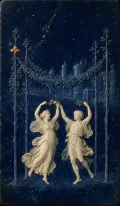 Four of WandsShares: The living staff · Six falling leaves · Castle on the hill · The hand from the cloud
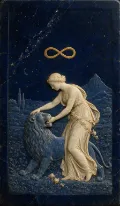 StrengthShares: Full moon and Milky Way · Two ivory cypresses · The hand from the cloud
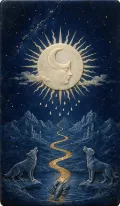 The MoonShares: Full moon and Milky Way · Spiralling ivory cloud · Castle on the hill
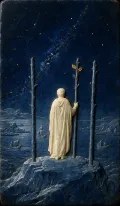 Three of WandsShares: Six falling leaves · The living staff · The hand from the cloud