Minor Arcana · Swords
Seven of Swords
Tarot card meaning: upright, reversed and the symbols of the Olivia image
The Seven of Swords looks at strategy and stealth: going around rather than through, and whether a clever workaround serves your integrity or quietly costs it.
- Upright
- strategydiscretiongoing it aloneclever workaroundevasion
- Reversed
- coming cleanplan unravellingself-deceptionoverreachingsecond thoughts
Upright
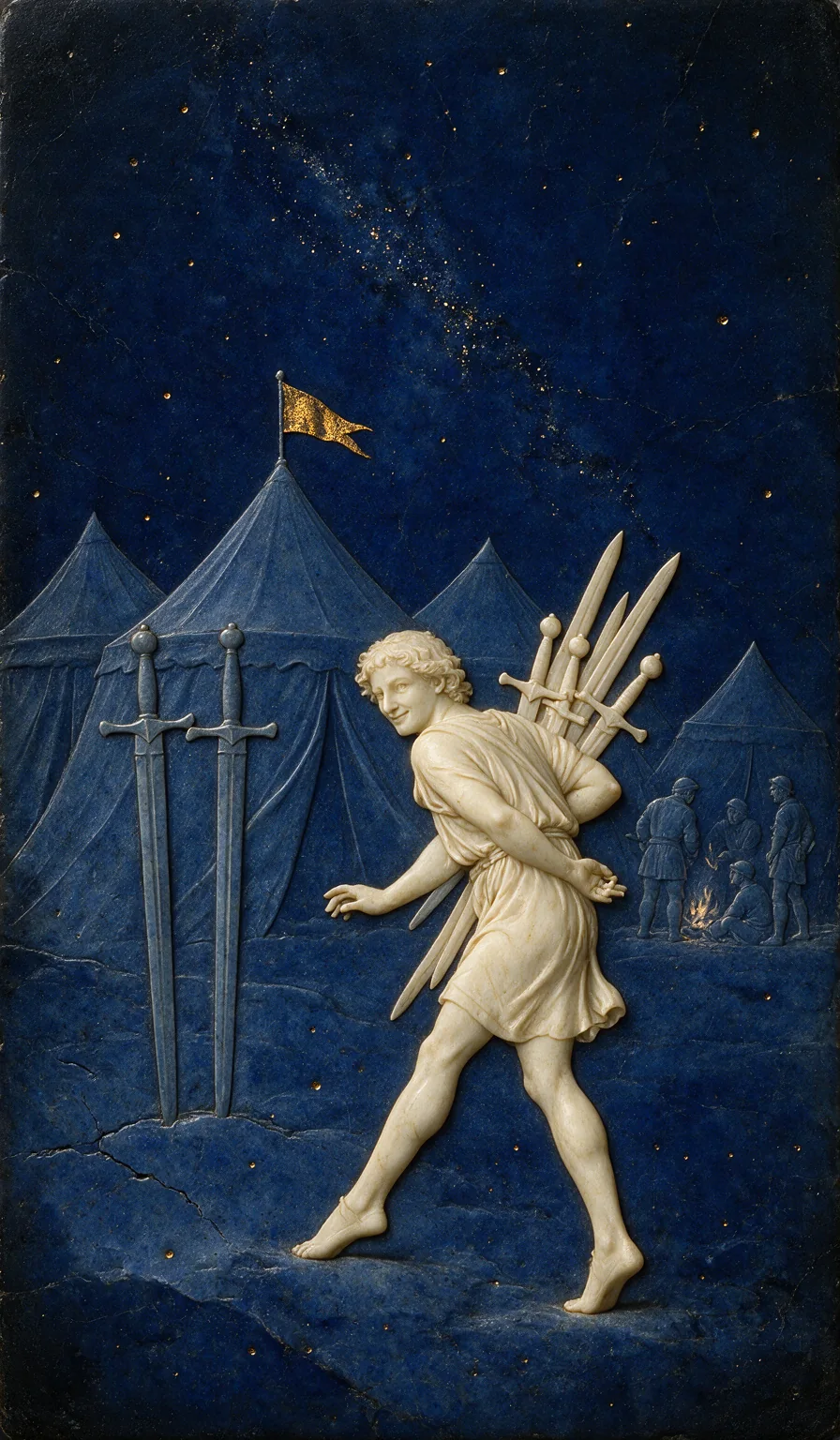
The Seven of Swords draws attention to a way of acting that goes around rather than through. In Olivia’s carving it is night: the Milky Way glitters across the lapis sky, tents stand in lighter blue, and an ivory figure in a short belted tunic moves on tiptoe with an armful of swords held against the back. The soldiers at the campfire on the right face the flames; no one in the camp is watching. Only you are, because the figure turns a sidelong smile out of the card and meets your eye.
Swords belong to Air, to thought, words and plans, and this card often points to strategy: keeping something to yourself, finding a workaround, acting alone because the group would slow you down or say no. None of that is wrong in itself. Discretion can protect a fragile idea, and a quiet exit is sometimes the wisest one. The card asks what your cleverness is serving.
What makes this version telling is where the figure is heading. The outstretched hand reaches toward the two swords still planted in the ground, as if the bundle were not quite enough. The Golden Dawn called this card the Lord of Unstable Effort, and the image shows why: a plan that depends on not being seen can end up carrying more than it can comfortably hold. Upright, the card invites an honest look at your own strategy, not a verdict on anyone else’s honesty.
Reversed
Seven of Swords reversed draws attention to a strategy that is becoming hard to sustain. The armful of blades grows heavy, the tiptoe step tires, and the story you have told yourself about why the direct route was impossible may be wearing thin. This position can also bring relief: a secret you are ready to set down, a plan you choose to bring into the open, something borrowed that you decide to return.
Sometimes the reversal turns inward, toward quieter forms of self-deception: saying you are fine when you are not, or calling avoidance a strategy. The card offers no evidence about anyone else’s honesty. It asks what a plainer conversation would require, and what you would no longer need to carry once you had it.
Read the image
Every element below is carved into this card. Scroll, hover or press a number to follow it on the image.
The sidelong smiling glance
What you seeThe ivory figure’s curly head turns three-quarters toward the viewer, lips curved in a small, knowing smile, eyes glancing sideways out of the card while the body keeps moving to the left.
What it carriesIn the traditional image the figure glances back toward the camp, a look commonly read as checking whether anyone has noticed. Olivia’s figure looks at you instead, and that changes the card: you become the only witness. The smile can read as mischief or as quiet confidence, and the card asks which belongs to your own plan.
The armful of swords
What you seeAbove the shoulder three ivory hilts with ball pommels and crossguards rise among three bare, upturned points; below the forward arm, three blade ends slant downward, one greyer than the rest. The bundle crosses the back diagonally.
What it carriesThe traditional image shows the taken swords carried together as one armful. Here hilts and points both rise over the shoulder, a tangle that is hard to count and awkward to hold. Carried plans and secrets are often like that: sharp at both ends, and never quite as tidy as they looked at the start.
Follow this symbol through the deck ↗The outstretched open hand
What you seeThe forward arm swings out to the left, fingers spread and loosely curled, the open hand hovering in the direction of the two planted swords. The other arm bends behind the back, its hand resting at the waist with fingers loosely curled.
What it carriesTraditional images of this card dwell on what is taken. This reaching hand adds a sense of wanting more: balance kept on tiptoe, or a reach toward the last two blades. It fits the Golden Dawn title, Lord of Unstable Effort: an attempt stretched a little too far.
Follow this symbol through the deck ↗Two swords left planted
What you seeTwo grey-blue swords carved in the lapis itself stand point-down in the ground on the left, side by side, with ball pommels and flared crossguards. Cracks in the stone run through the ground beneath them.
What it carriesTwo swords always stay behind in this card: the part of the task left undone, or what could not be carried. Here they are grey stone, not ivory, as if they still belong to the camp. They ask what you are leaving behind, and whether it will be noticed.
Follow this symbol through the deck ↗Soldiers at the campfire
What you seeOn the right, four small figures carved in grey-blue lapis gather round a fire flickering with gold: two stand, a third leans in just behind the flames, a fourth sits in front. All four face the fire.
What it carriesThe camp shows the group the figure is leaving or working around, and their attention on the fire is what makes slipping away possible. The card can ask what you do while others are not looking, and whether acting alone serves everyone involved or only you.
The gold pennant
What you seeA swallow-tailed pennant of glittering gold streams to the right from a slender pole with a knob at its tip, set on the peak of the largest tent. It is the largest patch of gold on the card.
What it carriesPennants mark whose camp this is and which way the wind blows; in the suit of Air the wind is thought itself. The flag streams right while the figure walks left, against it. Gold is rare in Olivia’s deck, and here it marks belonging and standing, not the blades.
The tents of the camp
What you seeFour peaked tents in lighter blue lapis stretch across the middle of the card. The largest has a scalloped valance; one is cut off at the left edge, another stands behind the fireside group.
What it carriesThe camp stands for the group: its shared rules and resources, the place you belong to or are leaving. In the traditional image the camp is simply close at hand; here the tents fill the horizon, a reminder that even a solo strategy happens inside a community with its own claims.
The Milky Way overhead
What you seeA broad diagonal band of pale, glittering mineral crosses the upper lapis sky from the upper left toward the lower right, with scattered gold flecks like stars above the tents.
What it carriesOlivia moves this scene from the traditional daylight into night. The Golden Dawn placed this card under the Moon in Aquarius, and darkness is what the plan depends on. Yet the sky is anything but blind: the stars see clearly what the camp does not.
Follow this symbol through the deck ↗Feet on tiptoe
What you seeBoth bare feet point left, a thin band at the front ankle. The rear foot rises high on its toes, heel lifted, while the front foot touches down toes first on the uneven lapis ground.
What it carriesTiptoeing is the classic body language of this card: movement that wants to make no sound. Nothing here is running; the stride is long, careful and deliberate. It suggests a strategy still in motion and reversible at every step, and the steady effort it takes to stay quiet.
The number
Seven follows the balance of Six and unsettles it. In the Minor Arcana sevens often bring a test: a position to defend, a choice to weigh, a moment when you act alone rather than with the group. In Swords, the suit of Air, thought and words, that test becomes strategy. After the Six of Swords crosses quiet water, the Seven works on dry land and by night, choosing cleverness over confrontation. It asks whether your plan is careful or merely evasive, and how much of it can hold.
The tradition
In the Golden Dawn system the Seven of Swords is titled the Lord of Unstable Effort. It is assigned to the Moon in Aquarius, the third decan of that sign (20 to 30 degrees), and to Netzach, Victory, the seventh Sephirah on the Tree of Life, expressed through the suit of Air. The changeable Moon in a detached, idea-led sign is often read as effort that starts brilliantly and then wavers. Aleister Crowley renamed the card Futility. Marseille decks show curved blades woven around a single straight sword; the scene of a figure slipping out of a camp with an armful of swords comes from Pamela Colman Smith’s 1909 design, which Olivia moves from daylight into night.
Love, work and self
- Love
- In close relationships the Seven of Swords can point to what goes unsaid: a feeling held back, a need handled alone, a hard conversation avoided by a clever detour. It does not tell you whether anyone is being dishonest with you, and it is not evidence of that. It asks about your own part. Is privacy protecting something tender, or has discretion turned into distance? The figure in this carving smiles only at the viewer; notice who, if anyone, is allowed to see the whole of you, yourself included.
- Work
- At work or in study this card can reflect independent tactics: working around a slow process, keeping an idea private until it is ready, quietly taking on more than your share. Swords ask for clarity, so check which of your shortcuts are genuinely efficient and which leave something unfinished for someone else to find. Where agreements, credit for work or money matters are involved, a transparent record and, when needed, a qualified person’s view serve better than a clever workaround.
- Self
- For your relationship with yourself, the card turns attention to the stories you tell to avoid discomfort. The swords ride on the figure’s back, out of its own sight, behind a bent arm: some burdens are easiest to carry when you do not look at them. Notice what you are managing privately, and whether it still needs to stay hidden. Honesty with yourself can be small and gentle: one true sentence, written only for you.
In a spread
Read the card through each position before you look at Olivia’s version. A position is a question, and the same card answers each one differently.
The situation
What aspect of the situation deserves attention?
Olivia’s readingAt the centre of a question, the Seven of Swords can point to a strategy or a secret that may shape everything around it. Looking at it honestly may matter more than perfecting the plan.
What complicates it
What tension or assumption deserves a closer look?
Olivia’s readingAs a challenge, the card can show a workaround that has become a habit, effort spread too thin, or avoidance presented to yourself as cleverness. The bundle may already be heavier than it looks.
A helpful next step
What small action could help you understand or respond?
Olivia’s readingAs advice, it invites discretion used with care: keep a plan quiet if it needs protecting, act on your own judgement, and check that nothing you carry belongs to someone else.
In conversation with
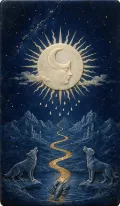
- Seven of Swords + The Moon
The Moon rules this card’s decan in the Golden Dawn system, and both images take place at night. Together they draw attention to what is hidden or half-seen, and to the difference between keeping a secret and being misled by your own fears.
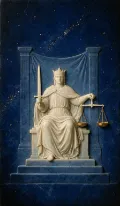
- Seven of Swords + Justice
Justice weighs actions and their consequences in plain view. Beside the Seven of Swords it turns attention to accountability: which of your choices you would be willing to explain openly, and what fairness would ask of the plan you are keeping quiet.
- Seven of Swords + Eight of Swords
The Eight of Swords follows the Seven: a figure standing bound among blades after a figure slipping away with them. Together they ask whether evasion is building the very constraints you hoped to avoid, and which of those constraints are really fixed.
Questions to keep
- Which part of your current plan depends on no one noticing, and why?
- What are you carrying that might be easier to set down than to keep hidden?
- If you took the direct route here, what would your first honest sentence be?
Ask them with three cards ↗A three-card reading in which each position asks one of these questions.
A small practice
Write down one thing you are handling quietly on your own, then name one person or place where it could safely be said aloud.
Cards that share its symbols
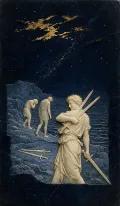 Five of SwordsShares: The sidelong smiling glance · The armful of swords · The outstretched open hand · The Milky Way overhead
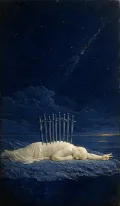 Ten of SwordsShares: The armful of swords · The sidelong smiling glance · The outstretched open hand · The Milky Way overhead
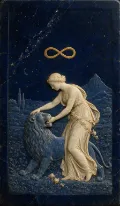 StrengthShares: The Milky Way overhead · The sidelong smiling glance · The outstretched open hand
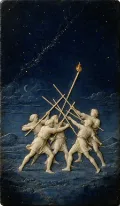 Five of WandsShares: The Milky Way overhead · The sidelong smiling glance · Soldiers at the campfire