Minor Arcana · Pentacles
Three of Pentacles
Tarot card meaning: upright, reversed and the symbols of the Olivia image
Skill becomes something lasting when it meets a shared plan: the Three of Pentacles honours craft, feedback and the respect that makes collaboration work.
- Upright
- craftsmanshipcollaborationshared standardslearning by doingearned respectbuilding together
- Reversed
- unclear rolesworking in isolationcredit disputescutting cornersplan without skill
Upright
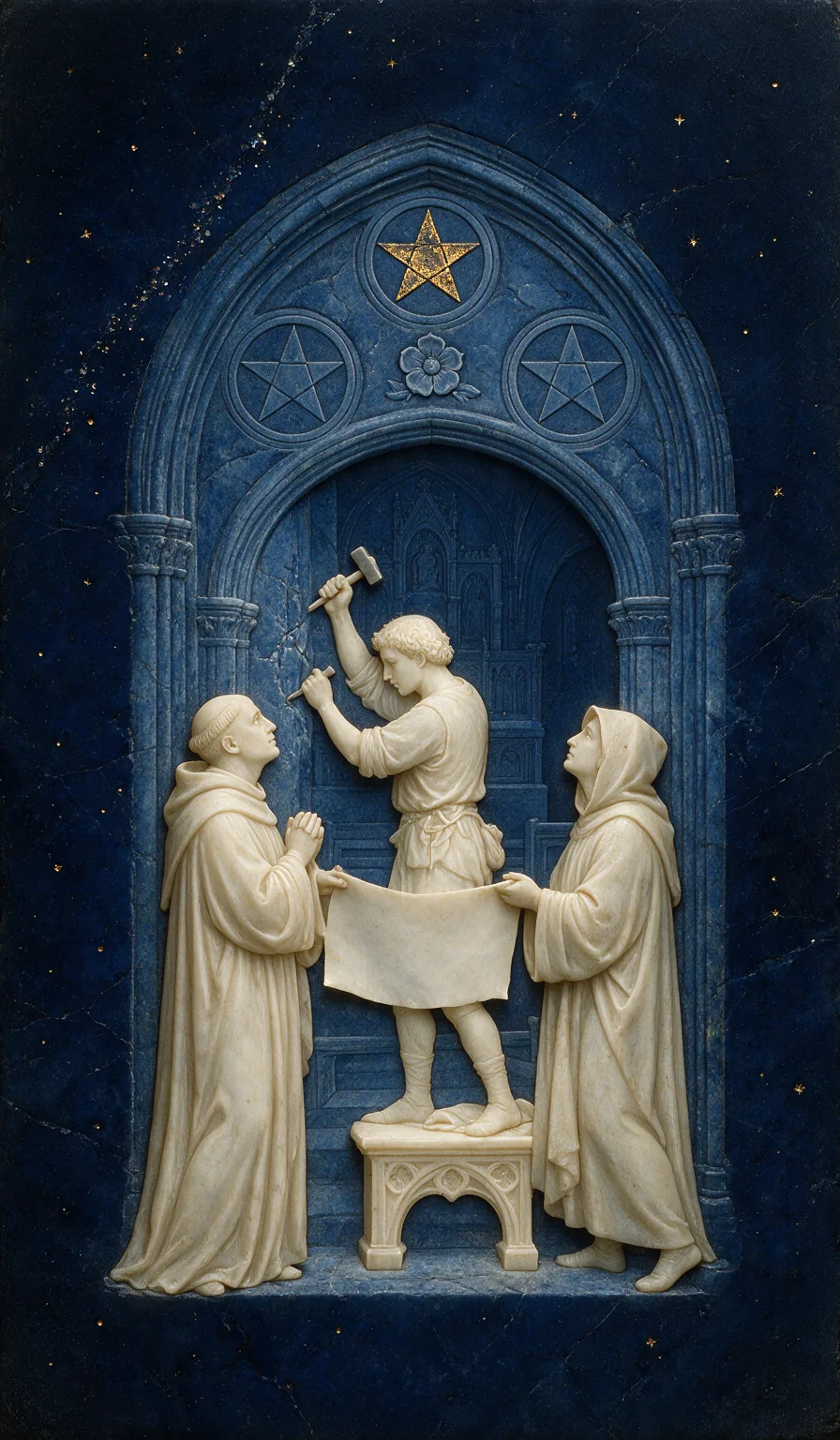
The Three of Pentacles is the card of work that needs more than one kind of skill. In Olivia’s carving, a worker stands on a bench inside a Gothic doorway, hammer raised and chisel set against the stone, while two robed figures look up and hold a plan open between them. Nobody here does everything. One shapes, one keeps the design, one brings purpose and blessing. The card draws attention to what becomes possible when each part is done well and each person knows where their part fits.
Look at where the gold falls. Of the three pentacles carved into the arch, only the highest is gilded, while the two below stay in the stone’s own blue. The card invites you to notice the common standard that sits above everyone’s individual contribution, and to let that standard, not status, guide the conversation. It can point to a stage where your competence is visible and worth offering, and where specific feedback from people who see the whole plan sharpens it.
This is also a card of learning inside real work: an apprenticeship, a first professional project, a group that teaches as it builds. Behind the worker, a whole cathedral façade is carved in the lapis, far larger than the patch of wall being worked on. Your piece matters because it joins something bigger, and the card asks you to give it your best attention.
Reversed
Three of Pentacles reversed turns attention to shared work that has lost its common plan. Roles may be blurred, so effort is duplicated while something important falls between the gaps; or one person does the shaping while others hold a plan nobody has explained. It can also point to skill kept to yourself, when asking for or offering feedback would make the result stronger.
In its inward form, the reversal can describe doubting your own craft so much that you never step up onto the bench, or polishing a private piece that no one else is allowed to see. Before pushing harder, it invites you to check three things: whether everyone is working to the same standard, who is responsible for what, and whose contribution has not yet been credited.
Read the image
Every element below is carved into this card. Scroll, hover or press a number to follow it on the image.
The gold pentacle above
What you seeAt the apex of the pointed arch, inside a moulded circle, a solid five-pointed star is inlaid in gold; it is the only gold on the carved architecture and sits above the other two.
What it carriesThe pentacle is the suit’s emblem of earth: body, material, money, work made real. Setting the one gold star at the top of the triangle suggests a shared aim held above the individual contributions, the standard everyone is working towards rather than any one person’s share.
Follow this symbol through the deck ↗Two lapis pentacles
What you seeLower left and lower right of the gold star, two pentagrams are cut into the lapis inside raised circles of matching size, drawn in outline with their inner lines and left in the stone’s own blue.
What it carriesThe traditional image carves the three pentacles into the church stonework. Here two are uncoloured outlines and one is solid gold, so the triangle reads as two hands of work supporting a single finished value: contribution first, recognition shared.
Follow this symbol through the deck ↗The carved five-petalled flower
What you seeBetween the two lower pentacles and directly beneath the gold one, a single five-petalled flower with a round centre and small leaves at either side is carved in the lapis of the arch.
What it carriesA five-petalled rose echoes the pentacle’s five points and is commonly read as beauty that is cultivated rather than found. The Golden Dawn set this card’s pentacles on a rose branch; Olivia carves a single rose as the quiet place where skill turns into grace.
Follow this symbol through the deck ↗The Gothic doorway
What you seeA tall pointed arch, carved in pale lapis, rests on clustered columns with carved capitals; within its inner arch a church façade with spires, tracery windows and a statue in a niche is cut in shallow relief.
What it carriesThe church or cathedral setting is the classic sign of this card: a building no single person could raise, made over years by many trades. Olivia carves the whole building in the background, so the small repair in front is shown as one part of a much larger work.
Follow this symbol through the deck ↗Hammer and chisel
What you seeThe curly-haired ivory worker raises a block-headed hammer in one hand and sets a chisel against the wall with the other; fine cracks run through the lapis around the chisel’s point.
What it carriesThe mason at work is the heart of the traditional image: skill applied, not merely possessed. The cracks in the stone suggest this may be mending as much as making, careful attention to an existing structure. The worker faces the stone, absorbed, while the others look up.
The tonsured figure’s joined hands
What you seeOn the left, a figure in an ivory monastic habit with a tonsured head looks up at the worker, palms pressed together at the chest; a lowered hood lies around the shoulders.
What it carriesA monk traditionally stands for the institution, the tradition or the client whose purpose the work serves. The joined hands add reverence: the onlooker honours the skill rather than directing it, a picture of respect flowing towards expertise.
Follow this symbol through the deck ↗The hooded onlooker
What you seeOn the right, a figure in a long ivory robe with the hood raised over the head looks up at the worker in profile, holding the right corner of the open sheet at chest height.
What it carriesThe second observer is commonly read as the patron, architect or keeper of the plan. With face turned upward and hands occupied, this figure is both supporter and custodian: the one who keeps the vision while another shapes the stone.
Follow this symbol through the deck ↗The plan held open
What you seeA broad, blank ivory sheet is held open by its upper corners between the two onlookers, hanging in front of the worker’s waist and thighs; nothing is drawn on its visible face.
What it carriesThe plan or drawing in the traditional image stands for design, agreement and a common standard. Olivia leaves the sheet blank, so the card turns attention to the fact that a plan is shared and held open, and leaves its contents to your own question.
The carved bench
What you seeThe worker stands on a low ivory bench whose front opens in an arch with three carved tracery panels above it; a folded cloth lies on its top beneath the feet.
What it carriesStanding on a bench to reach the work is part of the traditional image: the worker is raised, literally, by the task. Here the bench repeats the arch of the building, as if the tools and supports of the craft are made in the same spirit as the work itself.
The number
Threes follow the meeting of two with a first result: something now exists that neither part could make alone. In Pentacles, the suit of earth, body and practical life, that result is tangible: the first real product of skill, a piece of work others can see, use and judge. Where the Two of Pentacles juggles resources, the Three commits them to a plan. It asks for the patience of a craftsperson who knows this is a foundation stage, and for openness to the standards and eyes of other people.
The tradition
In the Golden Dawn system the Three of Pentacles is titled Lord of Material Works and assigned to Mars in Capricorn, the second decan of that earth sign. Mars is traditionally exalted in Capricorn, so the attribution pairs raw energy with discipline and structure. As a Three it belongs to Binah, the sphere of understanding and form. The Order’s own description placed three pentacles on a rose branch held by an angelic hand. Marseille-pattern decks show three coins among stylised foliage. Pamela Colman Smith’s 1909 design gave the card a scene: a sculptor working in a church arch while two onlookers, one holding a plan, look on, which is why it is read today as skill and collaboration. Crowley’s Thoth deck later named it Work.
Love, work and self
- Love
- In close relationships, including the one with yourself, the Three of Pentacles looks at what you are building together and how you divide the work of it. It invites you to name each person’s strengths plainly, to share the plan instead of assuming it, and to show appreciation for care that is practical: the repair done, the meal made, the routine kept. Respect for how each of you contributes can matter as much as how you feel.
- Work
- At work, in study or in handling money, this card favours clear roles, a shared standard and honest feedback on concrete work. It can point to a moment for showing your skill to people who can judge it well, for seeking a mentor, or for a project where your craft meets someone else’s plan. Ask what finished looks like, who decides it is good enough, and how each contribution will be credited.
- Self
- For your own growth, the Three of Pentacles asks you to treat a skill as something practised in company. Where could you let a more experienced eye look at your work, or offer yours to someone learning? The card honours humble, repeated effort, the chisel set against the same stone again and again, and invites you to take your competence seriously without needing it to be finished or perfect.
In a spread
Read the card through each position before you look at Olivia’s version. A position is a question, and the same card answers each one differently.
The situation
What aspect of the situation deserves attention?
Olivia’s readingAt the centre of your question may sit a piece of work that needs several people or several skills. The card draws attention to how well the plan, the craft and the purpose are joined.
What complicates it
What tension or assumption deserves a closer look?
Olivia’s readingWhat complicates things may be unclear roles, a plan nobody has fully shared, or skill that is not yet being seen or credited. It can also be hesitancy to ask for feedback.
A helpful next step
What small action could help you understand or respond?
Olivia’s readingShow a concrete piece of your work to someone who understands the whole plan, and ask for one specific improvement. Agree who is responsible for what before going further.
In conversation with
- Three of Pentacles + Eight of Pentacles
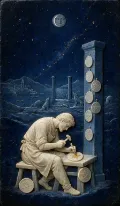
With the Eight of Pentacles, the same hammer, chisel and bench appear, first in company, then alone. Together they draw attention to how skill grows: through repetition on your own bench, then through testing it against a shared plan and other people’s eyes.
- Three of Pentacles + The Hierophant
With The Hierophant, both cards show robed figures, tradition and teaching. Together they can point to learning inside an institution or lineage, and ask how you honour established knowledge while still bringing your own hand to the work.
- Three of Pentacles + Five of Pentacles
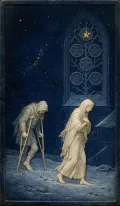
With the Five of Pentacles, both show Gothic stonework crowned by a single gold pentacle: here people work inside the arch, there two figures pass outside the window in the snow. Together they ask who is included in a shared project, and who could be invited in.
Also read withThree of CupsAll pairs ↗
Questions to keep
- Whose skill or perspective would improve this work if you made clear room for it?
- What would a shared standard for “good enough” look like here, and who needs to agree it?
- Where are you ready to show your craft to someone whose judgement you respect?
Ask them with three cards ↗A three-card reading in which each position asks one of these questions.
A small practice
Choose one piece of your current work and ask one person you trust for a single, specific piece of feedback; write down what you change as a result.
Cards that share its symbols
 Ace of PentaclesShares: The gold pentacle above · The tonsured figure’s joined hands · The carved five-petalled flower · The Gothic doorway
 Six of PentaclesShares: The gold pentacle above · The tonsured figure’s joined hands · The hooded onlooker
 The HierophantShares: The tonsured figure’s joined hands · The carved five-petalled flower
 StrengthShares: The tonsured figure’s joined hands · The carved five-petalled flower