Minor Arcana · Swords
Nine of Swords
Tarot card meaning: upright, reversed and the symbols of the Olivia image
The Nine of Swords gives shape to worry at its loudest: the sleepless hour when thoughts multiply and fear feels larger than anything in the room.
- Upright
- anxietysleepless worryoverthinkingnight fearsmental overload
- Reversed
- fear looseningworry kept secretreaching outmorning perspectivestuck in rumination
Upright
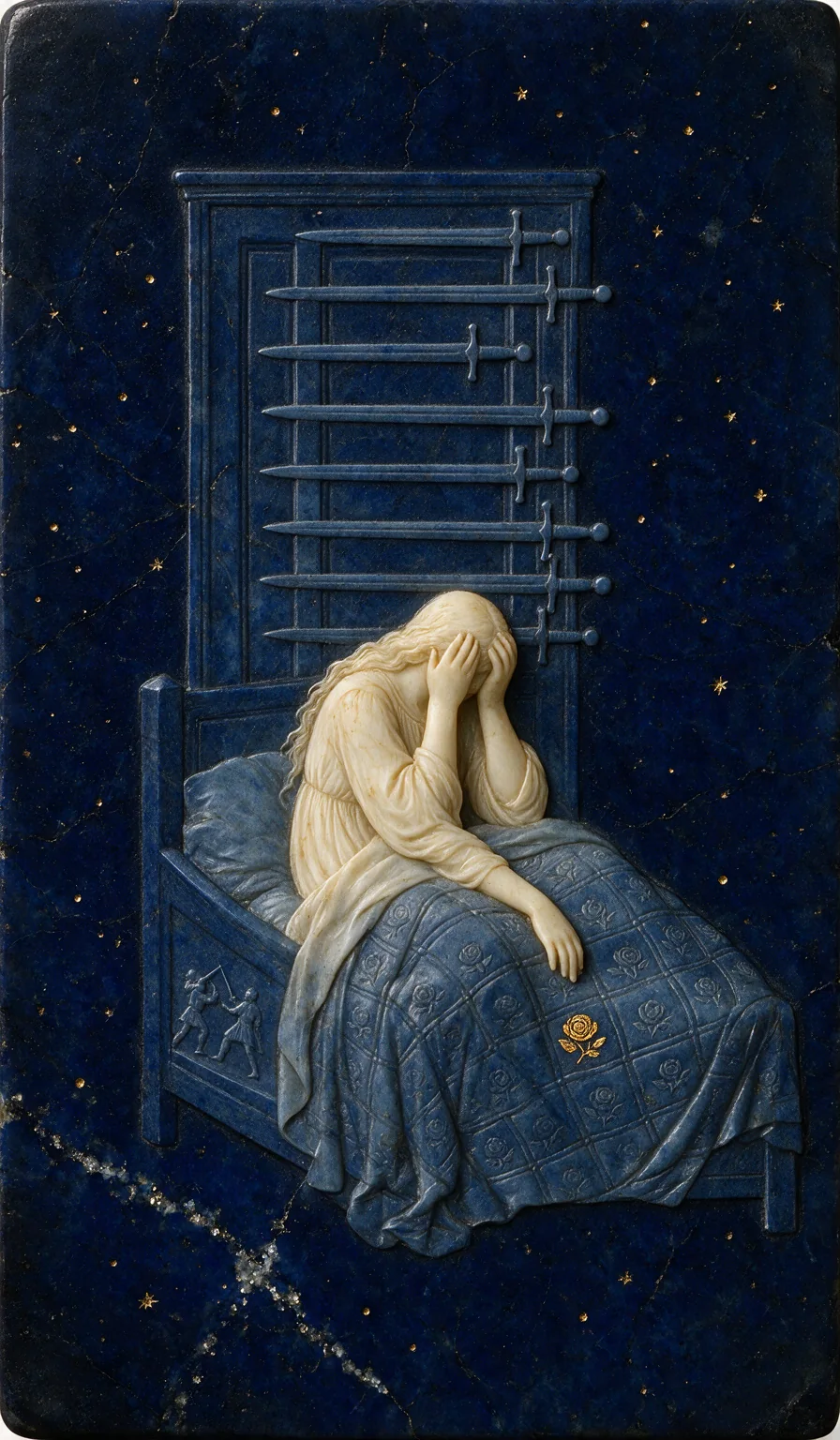
The Nine of Swords is the card of the three o’clock in the morning mind. It draws attention to worry that has grown larger than its occasion: thoughts that replay, sharpen and multiply once the lights are out and nothing can be done about them. In Olivia’s deck the ivory figure sits up in bed with hands pressed over the face while a slack forearm lies across the quilt. It is a picture of a body that is exhausted and a mind that will not stop.
Look closely at where the swords are. They hang in horizontal rows on a tall panel behind the bed, grey-blue lapis on blue, and not one of them touches the figure. Their hilts sit unevenly, like thoughts arriving out of order. The card is commonly read this way: the distress is real, but much of it lives in anticipation and replay, not in what is happening in the room. Count them and you find eight carved blades; the ninth may be the one the worried mind adds for itself.
Upright, the card invites you to take the fear seriously enough to look at it. Covering the eyes keeps out the room as well as the dread. Write the thought down, separate what you know from what you imagine, and notice the gold rose on the quilt, close to the resting hand. Distress this persistent also deserves company: a trusted person, or professional support if sleeplessness and anxiety are weighing on you. This is symbolic language for a state of mind, not a forecast.
Reversed
Nine of Swords reversed draws attention to worry that is either beginning to loosen or being held more tightly out of sight. You may notice the first grey light of perspective: a fear spoken aloud shrinks, a night passes, and the rows of swords look more like furniture than threats. Or the anxiety may have gone underground, carried privately because it feels shameful or too much to explain, so it circles without the check of another view.
Either way, this position asks what would let a little daylight in. Sharing part of the worry with someone you trust, writing it down or seeking support are not signs of failing to cope. You do not have to reason your way through the night alone.
Read the image
Every element below is carved into this card. Scroll, hover or press a number to follow it on the image.
Hands over the face
What you seeThe ivory figure’s head is bowed forward into the palms; long fingers spread across brow and eyes so that no face can be seen, and wavy hair falls loose down the back.
What it carriesThis gesture is the heart of the traditional card: dread that cannot be looked at and cannot be looked away from. Covering the eyes also shuts out the room, so the mind’s pictures fill the dark without being checked against what is actually there.
Follow this symbol through the deck ↗Eight carved lapis swords
What you seeEight swords, counted blade by blade, lie horizontally one above another across a tall panel, carved in pale grey-blue lapis, every point aimed left. None touches the figure; the lowest passes behind the bowed head.
What it carriesThe traditional card shows nine swords, the suit’s thoughts stacked like bars in the dark. Olivia’s carving shows eight. You may read the missing blade as the one the worried mind supplies itself: the worst-case thought no one else can see, added at night.
Follow this symbol through the deck ↗Staggered hilts and pommels
What you seeOn the right the crossguards and round pommels do not line up: each hilt sits a little further in or out than its neighbour, and several round pommels jut past the panel’s right edge onto the starry lapis.
What it carriesA hilt is where a sword is held, so the hilts suggest where a thought can be taken up and handled. Their uneven rhythm reads like thoughts arriving out of order, and the pommels crossing the panel’s edge like worry spilling past the frame it was given.
Follow this symbol through the deck ↗The tall panelled wall
What you seeBehind the bed rises a tall panel carved in the lapis, crowned with a moulded cornice and set with recessed frames, like a shut door or shutter; the swords are mounted across it.
What it carriesIn the traditional image the swords hang against plain darkness. Here they hang on something built, closer to a closed door or window than to open night. It gives the fear an architecture: a room of the mind with its shutters closed, while the starry sky carries on beside it.
Follow this symbol through the deck ↗Sitting up in bed
What you seeThe figure sits upright among the bedclothes in a loose ivory gown with gathered long sleeves, torso slumped forward over the quilt, one forearm lying slack across it with the hand hanging loose.
What it carriesTraditionally the figure has just woken, upright at the hour when rest should come. The slack forearm on the quilt shows exhaustion as much as fear: the body is spent while the mind keeps running, a familiar shape of sleepless worry.
The single gold rose
What you seeOn the quilt, a little below the hanging hand, one rose is inlaid in gold with a short stem and two leaves. It is the only gold anywhere on the bed or bedclothes.
What it carriesRoses in tarot speak of beauty, love and what still blooms. The traditional quilt carries many roses; Olivia gilds just one. Close to the resting hand, it quietly marks something precious and intact that the covered eyes are not yet seeing.
Follow this symbol through the deck ↗A quilt of carved roses
What you seeThe lighter blue quilt spills over the bed’s edge in heavy folds, stitched into a diamond lattice with a small carved rose in every compartment, repeated across the whole cover.
What it carriesThe traditional quilt mixes roses with astrological signs, a hint of a wider order around the sleeper. Here the pattern is roses only: steady, repeated, soft. The bed still offers warmth and comfort; the distress lies in the mind, not in what surrounds it.
Follow this symbol through the deck ↗The carved duel
What you seeOn the bed’s end panel at lower left, two small figures in tunics are carved in low relief, one swinging a sword overhead, the other stepping in with a raised blade.
What it carriesThe traditional bed carries a scene of one figure overcoming another, often read as an old conflict replayed while you lie awake. It is carved small and low, into the furniture: the fight is a memory worked into the bed, not an event in the room.
Gold stars beyond the panel
What you seeSmall gold flecks and a few tiny starbursts are scattered across the dark lapis around the panel and the bed, from the top corners down to the lower edge.
What it carriesThe traditional card sets its swords against a black night. Olivia’s night keeps its stars, just outside the panel where the swords hang. The larger sky has not vanished; worry narrows the view, and the room it narrows to is smaller than the night.
Follow this symbol through the deck ↗
The number
Nine is the last single number, the fullness of a suit just before the Ten tips it into completion or overload. In Wands that fullness is stamina, in Cups contentment, in Pentacles self-sufficiency. In Swords, the suit of Air and thought, it means a mind with no room left: every idea examined, every outcome rehearsed. The Nine asks you to notice when thinking has stopped solving and started circling, and to meet that saturation with rest, words and company rather than more thought.
The tradition
In the Golden Dawn system the Nine of Swords is titled the Lord of Despair and Cruelty. It is assigned to Mars in Gemini, the third decan of that sign (20 to 30 degrees), and to Yesod, the Foundation, the ninth Sephirah, linked with the Moon, dreams and imagination, here expressed through Air. Mars’s sharpness in quick, doubling Gemini is often read as thought turning on itself. Aleister Crowley shortened the title to Cruelty. Marseille decks show only an interlaced pattern of blades. Pamela Colman Smith’s 1909 design introduced the now familiar scene: a figure sitting up in bed, face in hands, beneath nine horizontal swords, with roses and astrological signs on the quilt and a carved combat on the bed.
Love, work and self
- Love
- In close relationships the Nine of Swords often points to worry about a bond more than to anything the bond has actually shown: replaying a message, imagining what another person must be thinking, rehearsing a painful conversation at night. The card cannot tell you what someone else feels. It asks you to notice which fears are built from evidence and which from the dark, and whether a calm daytime conversation, or simply reassurance from yourself, would serve better than another sleepless draft.
- Work
- At work or in study, the card can reflect a deadline, a mistake or a decision that has taken over the hours meant for rest. Swords ask for clarity, so turn the swirl into a list: what is actually due, what is within your control, what can wait until morning. Where money or practical matters are weighing on you, a conversation with a qualified person usually helps more than running figures through the night alone.
- Self
- For your relationship with yourself, this card turns attention to how you treat your own mind when it is frightened. The figure’s covered face and slack arm show both fear and tiredness, and both deserve care. Notice the patterns of your worry: the hour it comes, the phrases it repeats. If anxiety or sleeplessness has become a steady companion, it is worth speaking to a doctor or counsellor; asking for help is part of looking after yourself.
In a spread
Read the card through each position before you look at Olivia’s version. A position is a question, and the same card answers each one differently.
The situation
What aspect of the situation deserves attention?
Olivia’s readingAt the centre of a question, the Nine of Swords can point to worry that may have grown larger than the situation itself. Separating the fear from the facts may be the real work here.
What complicates it
What tension or assumption deserves a closer look?
Olivia’s readingAs a challenge, the card can show a mind that rehearses the worst outcome over and over, or distress kept private until it crowds out sleep, perspective and the people who could help.
A helpful next step
What small action could help you understand or respond?
Olivia’s readingAs advice, it invites you to write the fear down, check it against what you know by daylight, and share a part of it with someone you trust.
In conversation with
- Nine of Swords + Eight of Swords
With the Eight of Swords the pair traces a sequence of the mind: first blindfolded and loosely bound among blades, then awake beneath them in bed. Olivia’s carvings swap the counts, nine blades around the Eight and eight above the Nine, a quiet reminder that fear rarely counts accurately.
- Nine of Swords + The Moon
The Moon belongs to night, dreams and uncertain shapes, and in the Golden Dawn system the Nine of Swords sits in Yesod, the sphere linked with the Moon. Together they ask which fears come from the dark itself rather than from what is really there.
- Nine of Swords + Nine of Cups
The Nine of Cups shows fullness as satisfaction; the Nine of Swords shows fullness as a mind with no room left. Side by side the two nines ask what you are filling yourself with, and what contentment would need from your thoughts.
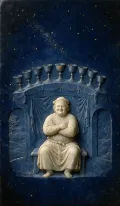
Also read withTen of SwordsAll pairs ↗
Questions to keep
- Which part of this worry rests on something you know, and which part on something you imagine?
- What does this fear usually say to you at night, and how does it sound in daylight?
- Who could you trust with even a small part of what keeps you awake?
Ask them with three cards ↗A three-card reading in which each position asks one of these questions.
A small practice
Before sleep, write the worry in one sentence on paper, add one thing you know to be true, then close the notebook until morning.
Cards that share its symbols
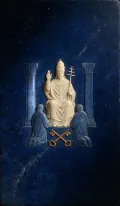 The HierophantShares: Hands over the face · Sitting up in bed · The single gold rose
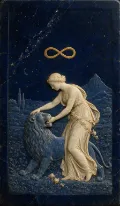 StrengthShares: Hands over the face · The single gold rose · A quilt of carved roses
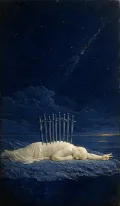 Ten of SwordsShares: Eight carved lapis swords · Hands over the face · Sitting up in bed
 King of SwordsShares: Eight carved lapis swords · Gold stars beyond the panel · Hands over the face