Minor Arcana · Cups
King of Cups
Tarot card meaning: upright, reversed and the symbols of the Olivia image
The King of Cups is steadiness in the presence of strong feeling: holding the cup level, keeping the heart close, and answering the waves with care.
- Upright
- emotional balancecalm authoritydiplomacycompassionate counselsteady care
- Reversed
- emotional distanceheld-back feelingmood swingscaretaker fatigueunspoken needs
Upright
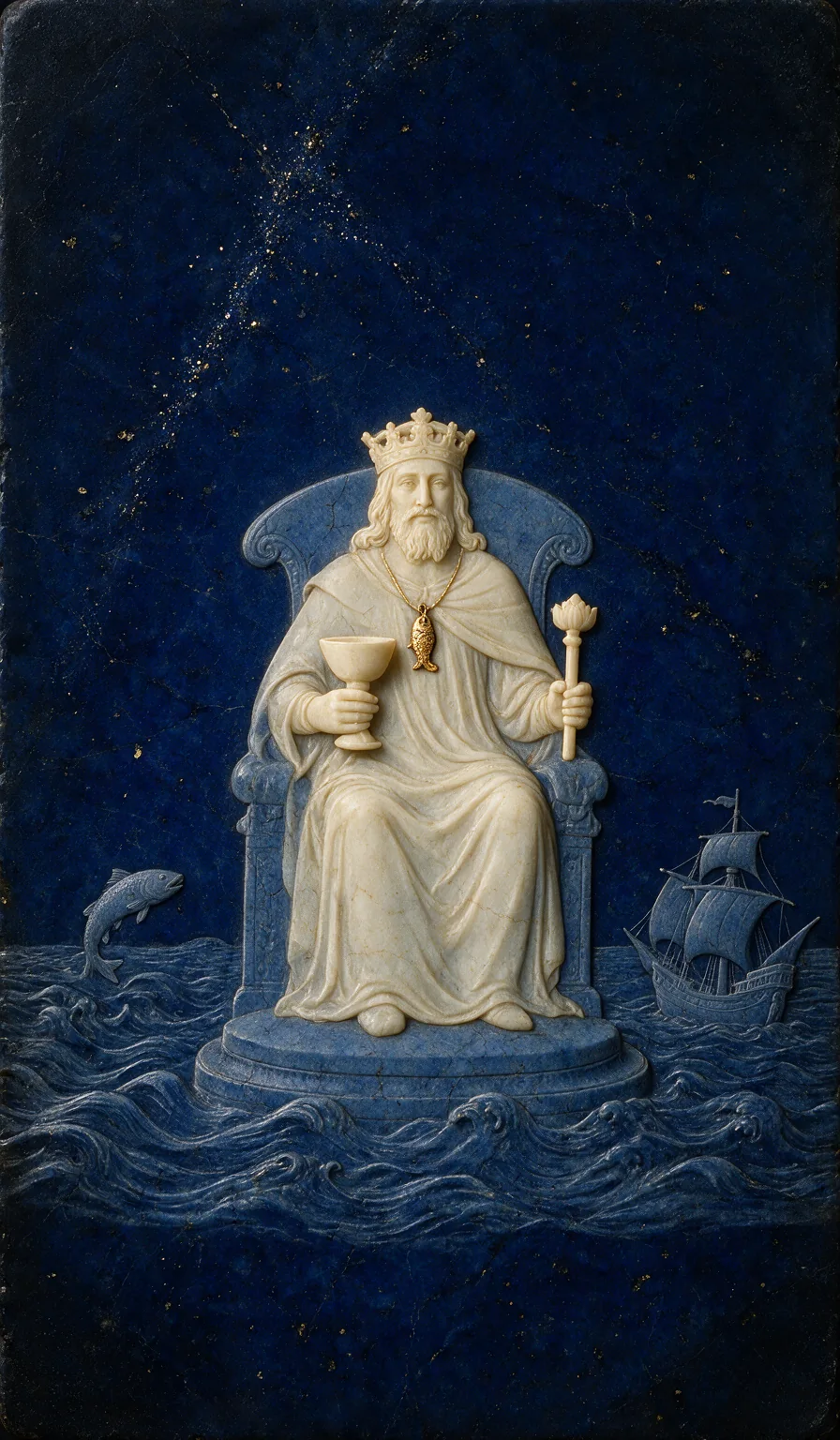
The King of Cups draws attention to a particular kind of maturity: remaining steady while the water moves. In Olivia’s carving the King sits facing forward on a scrolled throne of pale lapis, raised on a round, stepped dais in the middle of the sea. Below, the waves curl and break; a fish leaps on one side and a ship rides on the other. The King looks at neither. The ivory cup is held upright and level in one hand, the lotus-topped sceptre in the other, and nothing spills.
The only gold on the figure is a small fish hanging from a fine chain at the chest. It is worth noticing what Olivia chose to gild: not the crown, not the sceptre, but a creature of the deep worn over the heart. This King has feelings, and they are treasured, not denied. What makes the calm trustworthy is that it rests on real depth.
Upright, the card invites you to respond rather than react. It can point to a moment when your steadiness helps others, when listening, choosing your words and offering care in measured amounts serves better than a flood of emotion would. It also asks that calm include honesty: name what you feel, briefly and kindly, so that no one has to guess what the still surface holds.
Reversed
King of Cups reversed can show calm held so tightly that it turns into distance. The cup stays level, but no one is invited to drink from it; feelings are managed, explained away or saved for later, until they surface as sudden moods or a quiet withdrawal. The reversal can also point to the role of the one who holds everyone else’s feelings, with no room left for your own.
Look again at the gold fish on the chest: the deep is meant to be worn close, not locked away. Consider where you could let one feeling be known in plain words, and where caring for others might include a limit. Steadiness returns more easily when it no longer has to hide anything.
Read the image
Every element below is carved into this card. Scroll, hover or press a number to follow it on the image.
The gold fish pendant
What you seeA small gold fish, its body covered in fine carved scales, hangs head up from a thin gold chain at the centre of the chest; fish and chain are the only gold on the ivory figure.
What it carriesA fish amulet belongs to the traditional King of Cups: a creature of the deep worn openly, feeling and imagination kept close rather than hidden. Olivia gilds nothing else on the figure but this fish and its chain, so the inner life becomes the King’s real treasure.
Follow this symbol through the deck ↗The ivory cup, held level
What you seeThe hand on the viewer’s left grips the stem of a plain ivory goblet with a deep, rounded bowl, a knop on the stem and a flared foot, holding it upright at chest height, close to the body.
What it carriesThe cup is the suit’s emblem of water: feeling, love, imagination and receptivity. The traditional King holds it in the right hand, as here. Kept upright and level, nothing spills: emotion carried with care, available to others without being poured out over them.
Follow this symbol through the deck ↗The lotus-topped sceptre
What you seeThe other hand grips a short, slender ivory sceptre near its lower end; the shaft rises to a small collar and ends in a carved flower head of layered, pointed petals, like a lotus bud.
What it carriesA short sceptre in the left hand is traditional for this King: authority used lightly. Olivia crowns it with a lotus, the flower that roots in mud and opens on water, and the Golden Dawn’s Prince of Cups also holds a lotus. Leadership here grows out of depth.
Follow this symbol through the deck ↗The ivory crown
What you seeAn ivory crown with a decorated band and upright points ending in small trefoils, the tallest at the front centre, rests on long, wavy ivory hair; it is carved plain, without gold.
What it carriesThe crown marks rule, but in the suit of Cups the realm is feeling and relationship. Olivia leaves the crown in ivory and gilds only the fish pendant and its chain, so status matters less here than what the King keeps close to the heart.
Follow this symbol through the deck ↗The scrolled blue throne
What you seeA throne carved in paler, greyer lapis rises behind the King, its arched back ending in spiral scrolls at both upper corners; the armrests and square side posts carry shallow carved panels.
What it carriesIn the traditional image the throne is a heavy stone seat set out in the sea. Here it is cut from the same family of blues as the water and the sky: a steadiness that belongs to the element of feeling instead of standing against it.
Follow this symbol through the deck ↗The leaping fish
What you seeAt the left, a large scaled fish carved in grey-blue lapis arcs up out of the waves, tail still in the water, mouth open and head turned towards the throne.
What it carriesWaite describes a dolphin leaping on one side of the throne, commonly read as the vitality of the unconscious, feeling rising to the surface. Olivia carves a fish rather than a dolphin, echoing the gold pendant: the same creature worn close and alive in open water.
Follow this symbol through the deck ↗The sailing ship
What you seeOn the right, a tall ship with full, bellied sails and a pennant at the top of its highest mast rides the waves; raised decks and fine rigging lines are cut into the grey-blue lapis.
What it carriesA ship appears in the traditional card too: human skill carried safely across unstable water. Set opposite the leaping fish, it pairs instinct with navigation. The King sits between the two, able to honour the deep and still steer a course through it.
Follow this symbol through the deck ↗The round stepped dais
What you seeThe throne stands on a round lapis plinth of two stepped tiers, pale blue and finely cracked, its lower edge lapped by carved waves; the King’s ivory feet rest on the upper tier.
What it carriesThe traditional King’s throne rests on a stone block in the open sea, grounded in the middle of movement. Olivia turns it into a round, stepped dais rising clear of the waves: a stable place built on purpose, from which feeling can be met rather than avoided.
Follow this symbol through the deck ↗The rolling waves
What you seeA broad band of sea in deep and pale blue lapis crosses the lower card, its crests curling into small spirals that break against the dais, above a plain dark lapis margin.
What it carriesWater is the suit’s element, and a restless sea around the throne is traditional for this King. The waves are active, even turbulent, while the figure sits still: the card concerns not the absence of strong feeling but a calm response in its presence.
Follow this symbol through the deck ↗
The number
Kings are the outward mastery of their suit: they hold its element as responsibility for a wider realm. In Cups, the suit of water, that means feeling, empathy and imagination put at the service of relationships and communities. The Page receives an intuition, the Knight follows it, the Queen knows water from within; the King has learned to hold feeling steady for others, to comfort, mediate and advise without being carried off by the tide.
The tradition
In the Golden Dawn system the seated King of the 1909 deck is usually matched with the Prince of the Chariot of the Waters: Air of Water, the moving, communicating part of the element. Its span runs from 20° Libra to 20° Scorpio, covering the decans of the Four of Swords, Five of Cups and Six of Cups. Book T pictures this Prince in an eagle-drawn chariot over the sea, holding a lotus and a cup from which a serpent rises. Some modern readers give the King the Golden Dawn King’s place instead, Fire of Water. Marseille decks show a crowned King holding a cup; Pamela Colman Smith set the throne in a rough sea between a ship and a leaping fish.
As a temperament
- Temperament
- As a temperament, the King of Cups is warm, composed and attentive. This way of being feels things fully but does not act on the first wave; it listens, waits for the surface to settle, and then answers. It often becomes the steady presence in a room, the one others bring their troubles to, and it carries that trust seriously.
- Gifts
- The gifts here are emotional intelligence put to use: mediating a tense conversation, comforting without taking over, giving counsel that is kind and clear at once. This King can keep several people’s feelings in view, hold boundaries that are gentle but firm, and turn empathy and imagination into practical care, in a family, a team or a classroom.
- Shadow
- In shadow, composure becomes a mask. You may smooth over conflict instead of naming it, keep your own needs off the table, or let feelings build beneath the surface until they leak out as moods. Care can also slide into quiet control. The image offers a counterweight: the gold fish is worn on the outside, over the heart.
Love, work and self
- Love
- In love and close relationships, the King of Cups asks for warmth that is steady and honest. It can point to being the calm one when a partner, friend or family member is upset: listening before answering, without needing to fix everything at once. It also asks whether that calm leaves room for your own feelings to be spoken. With yourself, it invites the same patience: letting a strong emotion pass through without judging it.
- Work
- At work, in study and with money matters, this card favours emotional intelligence as a skill: reading the mood of a meeting, mediating between colleagues, giving feedback that someone can actually hear. It can point to roles that join care and responsibility, such as teaching, mentoring or leading a team. Consider where a measured response would serve better than a quick one, and where you might set a kind, clear limit on how much you absorb.
- Self
- For your own life, the King of Cups turns attention to how you hold your inner weather. Like the King raised on a dais above the waves, you might find a small, reliable place to stand when feelings run high: a walk, a notebook, a pause before replying. The card honours depth rather than detachment. Notice what you keep close to your heart, as the King keeps the gold fish, and whether it is allowed to be seen.
In a spread
Read the card through each position before you look at Olivia’s version. A position is a question, and the same card answers each one differently.
The situation
What aspect of the situation deserves attention?
Olivia’s readingAt the heart of a question, this card suggests the matter turns on emotional steadiness: responding with care and composure while strong feelings, yours or other people’s, are moving around you.
What complicates it
What tension or assumption deserves a closer look?
Olivia’s readingAs a challenge, it can show calm that has become a lid: feelings managed instead of expressed, or so much care for others that your own needs go unheard.
A helpful next step
What small action could help you understand or respond?
Olivia’s readingAs advice, it invites you to pause before answering, hold the feeling like a level cup, and then say something both kind and honest about what matters to you.
In conversation with
- King of Cups + Death
Death is given Scorpio and the Hebrew letter Nun, whose name means fish, and Scorpio falls within this King’s span. Together they draw attention to feeling that stays steady through symbolic endings and deep change, like the fish that lives on in any tide.
- King of Cups + Queen of Cups
The Queen of Cups is Water of Water, feeling at its most receptive and inward; this King is Air of Water, feeling that moves outward into words and relationships. Side by side they ask how what you sense privately can be shared with others.
- King of Cups + Five of Cups
The Five of Cups, Mars in Scorpio, is one of the decans within this King’s span. The Five looks at what has spilled; the King holds the cup level. Together they ask how sorrow can be felt fully and then carried with steadiness.

Questions to keep
- Where could you respond instead of react, and what would a measured answer sound like?
- What feeling are you holding level for others that might need to be spoken for yourself?
- What do you keep close to your heart, like the gold fish, and who is allowed to see it?
Ask them with three cards ↗A three-card reading in which each position asks one of these questions.
A small practice
Before your next difficult conversation, take three slow breaths and write two sentences: one that names what you feel and one that names what you need.
Cards that share its symbols
 Queen of CupsShares: The ivory cup, held level · The ivory crown · The scrolled blue throne · The round stepped dais
 Three of WandsShares: The sailing ship · The rolling waves · The round stepped dais
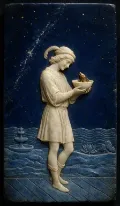 Page of CupsShares: The gold fish pendant · The ivory cup, held level · The rolling waves
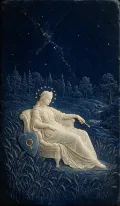 The EmpressShares: The lotus-topped sceptre · The scrolled blue throne