Minor Arcana · Wands
Knight of Wands
Tarot card meaning: upright, reversed and the symbols of the Olivia image
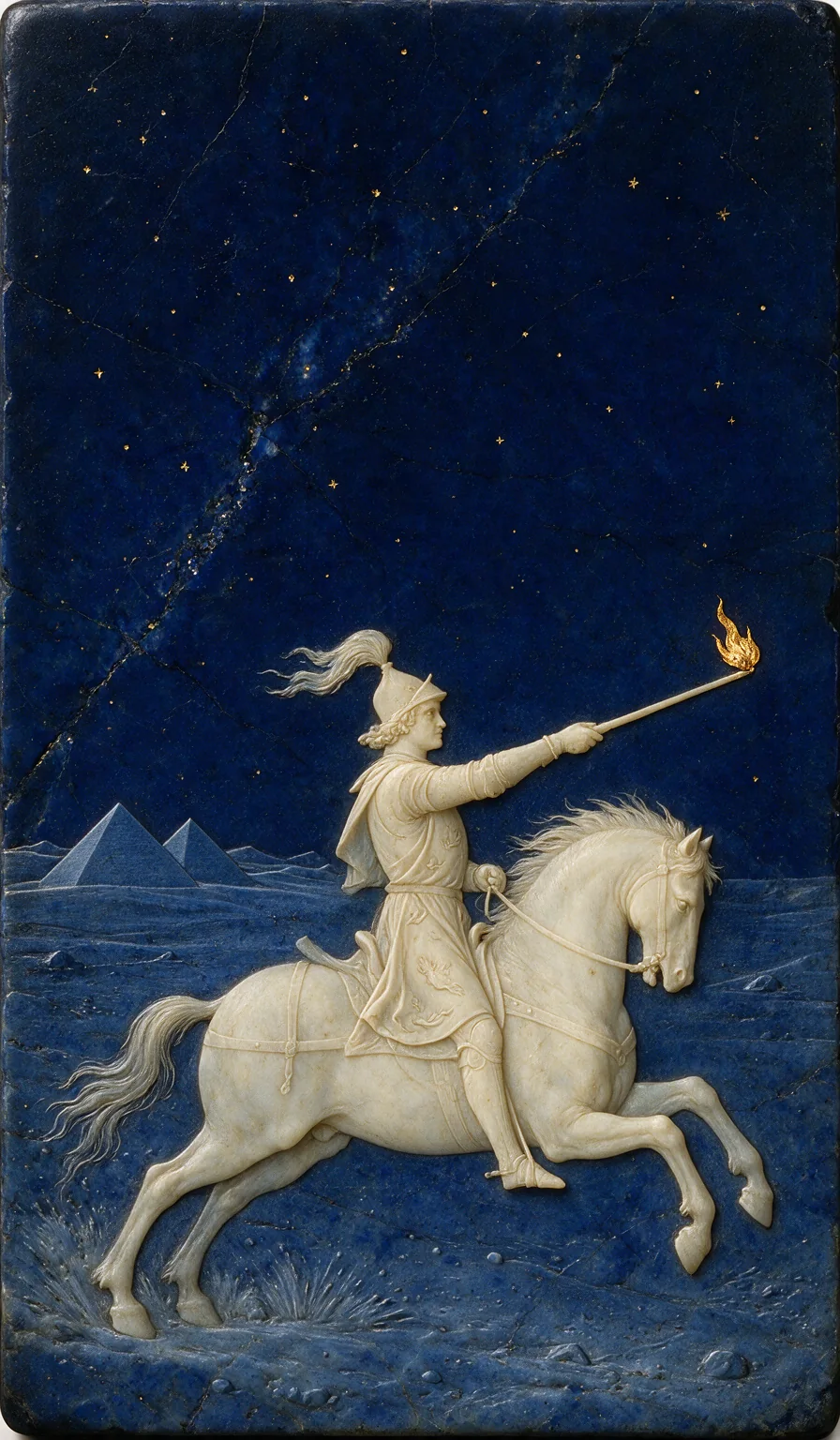
The Knight of Wands is desire in motion: the leap towards what excites you, carrying real fire, and the question of whether you can steer while you ride.
- Upright
- bold initiativeadventurepassionate drivecouragemomentumspontaneity
- Reversed
- impulsivenessscattered energyburnoutunfinished startsrestless delay
Upright
The Knight of Wands draws attention to the moment when wanting becomes moving. In Olivia’s image nothing is still: the plume streams flat behind the helmet, the tail and cape fly back, and the horse has both forelegs off the ground in a leap. The rider’s arm is fully extended, holding a bare wand out ahead with a gold flame burning at its tip. It is a picture of someone who has already set off.
This card honours that kind of courage. It can point to an idea you are ready to act on, a trip, a pitch, a conversation you have been circling, or simply a return of appetite after a flat stretch. Fire of Fire in the old system, this Knight carries the suit’s energy at full heat: charm, daring and the ability to make things start.
Look closer, though, and the image holds a second truth. The horse’s head is bowed and collected, the reins are gathered firmly in one fist, and the spur touches nothing. The flame leads, but a hand still guides. Upright, the Knight invites you to move while the fire is real, and to choose a direction worth the speed.
Reversed
Knight of Wands reversed can point to fire that has lost its rider. Enthusiasm may be scattering into several directions at once, or a string of eager starts may be leaving little finished behind. It can also show the opposite: energy that wants to move but is held back by circumstance or hesitation, until it turns into restlessness, irritability or tiredness.
The image offers a counterweight. The flame is carried forward on a long wand, not clutched against the body, and one hand stays on the reins. Reversed, the invitation is to slow the horse without putting out the fire: pick one direction, set a modest next step, and notice whether impatience is pointing to a real need for change or only to the dull middle of good work.
Read the image
Every element below is carved into this card. Scroll, hover or press a number to follow it on the image.
The gold flame
What you seeAt the far end of the wand a gold flame rises in several curling tongues, bending slightly back as if in a headwind; with the scattered star flecks, it is the only gold on the card.
What it carriesWands belong to fire, and as Fire of Fire this Knight is the suit’s element in its most concentrated court form. In the traditional image the rod sprouts green leaves; here it burns instead. The living growth has become open flame: energy at its most visible, and also at its least contained.
Follow this symbol through the deck ↗Plumed helmet, streaming back
What you seeThe rider wears a close ivory helmet with a pointed crown and a small peak over curly hair; a long plume springs from the top and streams back towards the left in loose strands.
What it carriesThe plume is a wind gauge. It tells you the horse is moving fast enough to pull everything backwards, and that the rider has chosen a direction and is already in it. The helmet is light, a travelling helmet rather than battle armour.
The bare wand, held forward
What you seeA long, smooth ivory wand is held out at the full stretch of one arm, angled upward over the horse’s head; it has no leaves or knots, only the flame at its tip.
What it carriesWaite describes a short wand, and in the 1909 card it sprouts fresh leaves. Olivia’s wand is bare and pointed ahead like a torch carried into the dark. It reads less as a weapon than as a direction: the arm says “there”, and the flame lights the way.
Follow this symbol through the deck ↗Two pyramids behind
What you seeTwo pyramids of paler, greyer lapis stand on the far left horizon, a larger one and a smaller one just to its right, with low ridges beyond and a flat, rippled plain stretching behind the horse.
What it carriesWaite described the rider passing mounds or pyramids, and the desert has long been read as the hot, dry country of the fire suit. Here the pyramids sit behind the Knight: ancient, patient structures being left in the dust by someone who has not stopped to look at them.
Follow this symbol through the deck ↗The horse’s bowed head
What you seeThe ivory horse’s head is tucked down and in, ears pricked forward, eye calm; a carved bridle crosses the face and the reins run back to the rider’s other fist, held low near the belt.
What it carriesThe horse is the Knight’s energy made into a body. In the traditional card it rears and strains; Olivia’s horse lifts its forelegs yet keeps its head collected. The rein hand matters: the fire is running, but one hand still asks it to listen.
Follow this symbol through the deck ↗Carved tunic motifs
What you seeThe rider’s belted ivory tunic falls over the saddle in soft folds, carved with small low-relief motifs: curling forms with trailing tails, scattered across the chest and skirt.
What it carriesPamela Colman Smith dressed this Knight in a tunic of salamanders, the creatures once believed to live unharmed in fire. Olivia carves the same idea quietly into the ivory: a temperament that feels at home in heat, and wears it as part of everyday clothing.
Forelegs in mid-leap
What you seeBoth forelegs are lifted clear of the ground and folded at the knee, hooves hanging; the hind legs stretch back and down, hooves planted beside tufts of dry scrub.
What it carriesWaite noted that the motion of the horse is a key to the rider’s character. This is the moment of take-off: weight thrown onto the haunches, front end already in the air. It is the card’s whole temperament in one gesture, committed before the landing is known.
Follow this symbol through the deck ↗The spurred heel
What you seeBelow a carved knee plate, the rider’s armoured shin ends in a pointed shoe with a strap across the instep; a small spur projects from the heel, below the horse’s belly and touching nothing.
What it carriesSpurs belong to the knightly world of urging a horse on. This one hangs free of the horse: the capacity to push harder is present, and in this instant it is not being used. Speed is available; it need not be forced.
The number
Knights are the movement of their suit: the rank that pursues, travels and carries the element out into the world. After the Page’s first spark of curiosity, the Knight of Wands rides with it. In Wands, the suit of fire, will and creative drive, that pursuit becomes adventure and initiative at their most intense. Before the Queen’s warm inner steadiness and the King’s directed vision, this rank shows fire as momentum: brave, contagious, and still learning how to last.
The tradition
In the Golden Dawn system this card is titled the Lord of the Flame and the Lightning, King of the Spirits of Fire: Fire of Fire. The Golden Dawn called its mounted court figure a King; the 1909 Waite and Smith deck renamed it Knight. Its zodiac span runs from 20° Scorpio to 20° Sagittarius, covering the decans of the Seven of Cups, Eight of Wands and Nine of Wands. Marseille decks show a Cavalier of Batons carrying a heavy club. Waite’s notes describe the rider on a journey rather than a warlike errand, passing mounds or pyramids; Pamela Colman Smith drew a rearing horse and a tunic patterned with salamanders.
As a temperament
- Temperament
- As a temperament, the Knight of Wands is quick, warm and restless: the part of anyone that lights up at a new idea and wants to be on the road towards it by morning. This way of acting trusts instinct and momentum, speaks with conviction, and feels most alive at the start of things, when everything is still possible.
- Gifts
- The gifts here are courage, charisma and the ability to get something moving. This temperament can break a stalemate, rally a group, say yes to the unknown and make an idea feel exciting enough that other people join in. It brings heat to cold projects and the nerve to begin before every doubt has been answered.
- Shadow
- In shadow, speed replaces direction. You may leap from one plan to the next, take on more than you can carry, or lose interest when the work becomes ordinary. Impatience can come across as carelessness towards others. Olivia’s horse holds the balance: it leaps, yet its head is collected and the reins are held.
Love, work and self
- Love
- In love and close relationships, the Knight of Wands brings heat, spontaneity and a wish to be swept up in something alive. It can point to a vivid beginning, or to rekindling play in a familiar bond: an unplanned outing, a bold word said out loud. It also asks whether your enthusiasm leaves room to stay once the first blaze settles. With yourself, it invites you to notice what still genuinely excites you.
- Work
- At work, in study and with money, this card favours initiative: pitching the idea, starting the project, taking on the task nobody else will try. It can show a burst of energy that gets things off the ground. Consider pairing that speed with one simple structure, a deadline, a checklist or a partner who finishes well, so the flame at the tip of the wand lights a path rather than a series of abandoned starts.
- Self
- For your own life, the Knight of Wands turns attention to appetite and aliveness: what makes you want to move, travel, try, create. Like the rider holding the flame out ahead, you might name one thing you are drawn towards and take a real step in its direction. The self-knowledge here is about pace: noticing when fire energises you and when it quietly burns you out.
In a spread
Read the card through each position before you look at Olivia’s version. A position is a question, and the same card answers each one differently.
The situation
What aspect of the situation deserves attention?
Olivia’s readingAt the heart of a question, this card suggests the matter may be about momentum: a desire or idea that is perhaps already moving, and the need to decide where that energy goes before it chooses for you.
What complicates it
What tension or assumption deserves a closer look?
Olivia’s readingAs a challenge, it can show haste or scattered enthusiasm: acting before listening, starting several things at once, or letting impatience with a slow middle stage pull you away from something worthwhile.
A helpful next step
What small action could help you understand or respond?
Olivia’s readingAs advice, it invites one bold, concrete move towards what excites you, taken today, with one hand still on the reins: a clear aim and a small plan for what follows.
In conversation with
- Knight of Wands + The Chariot
The Chariot and the Knight of Wands are both pictures of movement. The Chariot wins by holding opposing forces in check; the Knight wins by letting fire run. Together they ask whether this moment calls for control or for momentum.
- Knight of Wands + Eight of Wands
The Eight of Wands falls within this Knight’s zodiac span and shares its speed: messages, travel, things arriving at once. Side by side they draw attention to how quickly events can move, and to what you choose to do while they do.
- Knight of Wands + Knight of Pentacles
The Knight of Pentacles is commonly read as the slowest of the four Knights and the Knight of Wands as the fastest. Together they balance daring with endurance, and invite you to ask which pace your question actually needs.
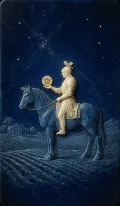
Questions to keep
- What are you already moving towards, and have you chosen that direction or simply followed the heat?
- Where would one hand on the reins make your enthusiasm more useful?
- What will keep this fire alive once the exciting start is over?
Ask them with three cards ↗A three-card reading in which each position asks one of these questions.
A small practice
Write the one thing you most want to start, then beneath it one small action for today and one for a week from now, so the leap has a landing.
Cards that share its symbols
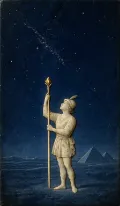 Page of WandsShares: The gold flame · The bare wand, held forward · Carved tunic motifs · Two pyramids behind
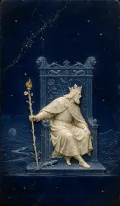 King of WandsShares: The gold flame · The bare wand, held forward · Carved tunic motifs
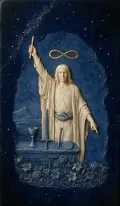 The MagicianShares: The bare wand, held forward · Carved tunic motifs
 The LoversShares: The gold flame · Carved tunic motifs