Minor Arcana · Pentacles
King of Pentacles
Tarot card meaning: upright, reversed and the symbols of the Olivia image
The King of Pentacles is steady, generous stewardship: building something solid enough to last, then using it to hold up the people and work around you.
- Upright
- stewardshippractical leadershipreliabilityearned securitygenerositypatient building
- Reversed
- controlhoardingrigid routinestatus worryoverwork
Upright
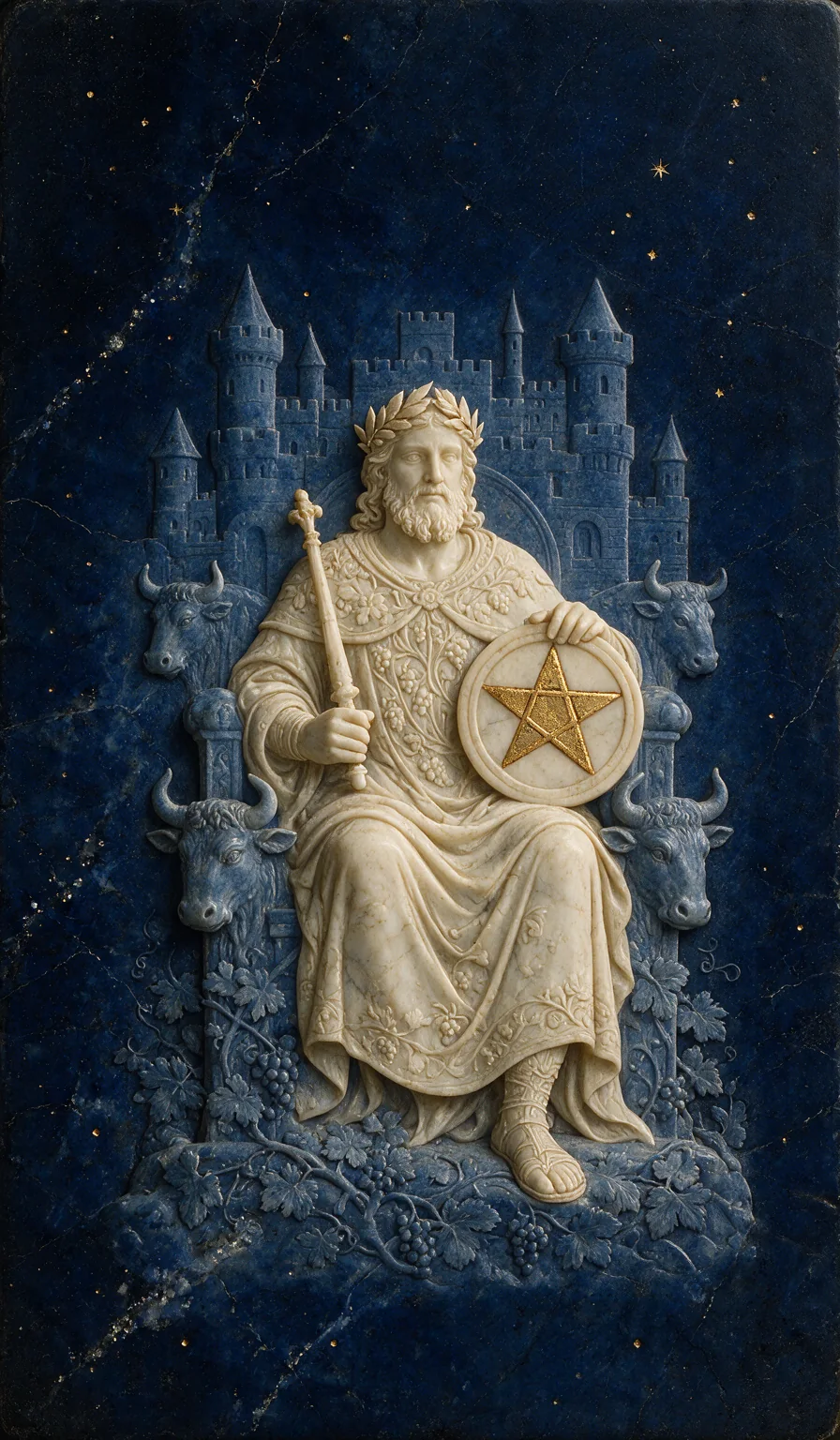
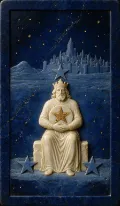
The King of Pentacles draws attention to what it means to be responsible for something that works. Where the Queen of the suit tends, the King sustains: the household, the business, the long project, the account others quietly rely on. In Olivia’s image the King sits squarely on a throne carved with four bulls’ heads, a lapis castle rising behind, and looks straight out at you. Nothing in the pose hurries. This is authority that has already been built, not one still being argued for.
Look at the hands. One holds an ivory sceptre angled up past the shoulder; the other rests lightly along the top rim of the disc, fingers curled over its edge rather than clutching it. The gold star is the brightest thing on the card, yet it stands at the King’s side, steady and open to view. Resources are present, counted and cared for, and they are not gripped.
Grapes are carved everywhere: on the robe, up the sides of the throne, across the ground beneath the sandalled foot. The card honours the harvest that comes from seasons of patient work. Upright, it asks how you can be dependable in a way that lets others grow too: keep the commitment you made, finish the practical task, set up the structure someone else will lean on. The laurel on the King’s head is a wreath for effort already given.
Reversed
King of Pentacles reversed can point to stewardship that has narrowed into control. Security may have become a goal in itself, measured by what can be counted, owned or protected, so that the resources meant to support a life begin to run it. The King’s steadiness can also turn into stubbornness: the same method applied long after conditions have changed, or work filling every hour because stopping feels unsafe.
Return to the hand resting on the disc. Reversed, the invitation is to loosen a grip: to ask whom your resources actually serve, to let someone else have a say in how they are used, or to spend a little of what you have kept on rest, pleasure or another person. Something stable can stay stable and still bend.
Read the image
Every element below is carved into this card. Scroll, hover or press a number to follow it on the image.
The lapis castle
What you seeA castle carved in greyed lapis fills the space behind the throne: crenellated walls, conical-roofed towers and small arched windows rise from the King’s shoulders to well above the laurel wreath.
What it carriesIn the suit of Pentacles a castle stands for what has been built and secured over time: property, institutions, a household that outlasts one season. The traditional image sets it in the distance; here it rises directly behind the throne, so the achievement backs the King up.
Follow this symbol through the deck ↗The laurel wreath
What you seeIn place of a crown, a wreath of pointed ivory laurel leaves circles the King’s head above long wavy hair; the calm face looks straight out at the viewer.
What it carriesLaurel was the classical wreath of victory and honour, given for something accomplished. The traditional King of Pentacles wears a crown; Olivia’s King wears a wreath instead, so the authority reads as earned through work rather than inherited, recognition rather than rank.
Follow this symbol through the deck ↗Four bulls’ heads
What you seeFour horned bulls’ heads carved in blue lapis project from the throne: two at the top corners of its back at shoulder height, two lower at the front corners of the seat, level with the King’s knees.
What it carriesThe bull is Taurus, the fixed earth sign inside this card’s Golden Dawn span, and an old image of strength, fertility and patient labour. The 1909 design also carved bulls’ heads on the throne; set here at all four corners, they make the seat itself a statement of grounded power.
The ivory sceptre
What you seeThe King’s right hand, on the viewer’s left, holds an ivory sceptre by its shaft, angled up past the shoulder; it ends in a knobbed, three-lobed finial above a ringed collar, with a rounded knob below the fist.
What it carriesA sceptre is the emblem of lawful authority, the right to decide and direct. In the traditional image this King’s sceptre is topped with an orb, the world held in hand; Olivia’s simpler finial keeps the rule practical and local, authority used to manage what is actually here.
Follow this symbol through the deck ↗Robe carved with grapes
What you seeThe ivory robe is carved with bunches of grapes, vine leaves and tendrils down the front and along the hem, with a band of flowers and a central rosette across the shoulders.
What it carriesGrapes are the traditional pattern of this King’s robe: the harvest worn as clothing. Fruit on the garment suggests abundance that has become part of how the King lives and moves, grown into character rather than locked away in a vault.
The gold pentacle
What you seeAn ivory disc with a raised rim stands upright on the King’s lap at the left side, on the viewer’s right; a gold five-pointed star with incised inner lines is inlaid on it, and the left hand rests along its top edge.
What it carriesThe pentacle is the suit’s emblem of earth: money, body, work, home and time made solid. Its star is the one gilded element of the carved figure and throne. The hand lies over the rim instead of gripping it, which is the card’s quiet lesson: resources held securely and without fear.
Follow this symbol through the deck ↗The vine underfoot
What you seeA lapis grapevine spreads across the raised ground beneath the throne, heavy with grape clusters and broad lobed leaves; tendrils climb both sides of the seat, and one sandalled ivory foot rests on the vine-covered ground.
What it carriesGrapes stand for harvest that takes years: vines are planted long before they bear fruit. Spread under the King’s foot, they show a life standing on cultivated plenty. The same vine runs through robe, throne and ground, so figure, seat and earth share one harvest.
Follow this symbol through the deck ↗
The number
Kings are the outward mastery of their suit: they carry its element into the world as responsibility, decision and example. In Pentacles, the suit of earth, that means knowing how things are made to last: money, bodies, buildings, routines, commitments of time. After the Page’s careful study, the Knight’s slow labour and the Queen’s tending, the King holds the whole estate and answers for it. This mastery shows as reliability that others can build on.
The tradition
In the Golden Dawn system the seated King of the 1909 deck is usually matched with the Prince of Pentacles, the Prince of the Chariot of Earth: Air of Earth, the part of the element that plans, weighs and circulates. Its span runs from 20° Aries to 20° Taurus, covering the decans of the Four of Wands, Five of Pentacles and Six of Pentacles. Book T pictures this Prince in a chariot drawn by a bull. Some modern readers give the King the Golden Dawn King’s place instead, Fire of Earth, 20° Leo to 20° Virgo. Older Marseille decks show a seated King of Coins holding a single coin; Pamela Colman Smith surrounded the King with bulls’ heads, grapevines and a castle.
As a temperament
- Temperament
- As a temperament, the King of Pentacles is steady, patient and practical. This way of acting prefers proven methods to bright ideas, thinks in seasons rather than days, and measures success by what is still standing later. It stays calm under pressure because it has usually planned for the lean months, and it speaks through what it provides and maintains.
- Gifts
- The gifts here are reliability, sound judgement about resources and a generous practicality. This King knows what things cost in time, money and effort, and can build structures that let other people get on with their work: a workable budget, a fair workplace, a home that holds. Its generosity is concrete, sharing means, skills and shelter rather than only advice.
- Shadow
- In shadow, steadiness hardens into control, and security becomes a goal that is never quite reached. You may measure worth, your own or other people’s, by output and possessions, resist every change as a risk, or carry every responsibility alone because delegating feels unsafe. The resting hand on the disc is the counterweight: hold what you have without gripping.
Love, work and self
- Love
- In love and close relationships, the King of Pentacles shows care as reliability: turning up, keeping the household running, remembering the practical things that make shared life easier. It invites you to notice how steadiness is given and received between you, and whether the practical side has crowded out tenderness or play. With yourself, it can mean becoming someone you can rely on, keeping small commitments to your own body, rest and time.
- Work
- At work, in study and with money, this card favours sound structures over quick wins: a clear budget, a realistic plan, systems that keep running when you are not watching them. It can point to a moment for taking responsibility for something that has grown, or for passing on skills you learned slowly. Consider what you are building to last, and whom it is meant to support.
- Self
- For your own life, the King of Pentacles turns attention to what you have already built: habits, skills, reserves of energy, a home, a body you have looked after. Like the laurel on the King’s head, it asks you to recognise effort that has borne fruit before rushing on to the next task. Self-worth here is solid and unshowy, drawn from what your hands and time have made.
In a spread
Read the card through each position before you look at Olivia’s version. A position is a question, and the same card answers each one differently.
The situation
What aspect of the situation deserves attention?
Olivia’s readingAt the heart of a question, this card suggests the matter concerns responsibility for something substantial: a household, a project, resources or a role that others depend on, and how to steward it well over time.
What complicates it
What tension or assumption deserves a closer look?
Olivia’s readingAs a challenge, it can show security or routine taking up so much room that change feels threatening, or a sense that everything rests on your shoulders and cannot be shared.
A helpful next step
What small action could help you understand or respond?
Olivia’s readingAs advice, it invites one steady, practical step: review what you hold, maintain what already works, and decide how some of it could support someone or something beyond yourself.
In conversation with
- King of Pentacles + The Emperor
With The Emperor, two enthroned rulers meet, and the Emperor’s sign, Aries, opens this King’s Golden Dawn span. The Emperor builds order and sets the rules; the King of Pentacles fills that order with harvest. Together they ask whether the structures you keep also feed the people inside them.
- King of Pentacles + Ten of Pentacles
The Ten of Pentacles shows the suit completed as a household and a legacy across generations. With the King, whose castle rises behind the throne, the pair draws attention to what you are building and who will live with it after you.
- King of Pentacles + Four of Pentacles
The Four of Pentacles is the suit’s picture of holding on tightly. Beside the King, whose hand rests lightly on the rim of the disc, the pair shows the difference between security that serves a life and security that confines it.
Questions to keep
- What are you building now that you would like to see still standing in ten years?
- Where does your sense of security depend on control rather than trust?
- Whom or what could your resources, skills or time quietly support this month?
Ask them with three cards ↗A three-card reading in which each position asks one of these questions.
A small practice
Write down three things you have built or maintained over the past year, however ordinary, and beside each one name a person or purpose it supports.