Minor Arcana · Swords
Four of Swords
Tarot card meaning: upright, reversed and the symbols of the Olivia image
The Four of Swords asks for a deliberate pause: laying down effort, letting a tired mind go quiet, and trusting that rest is part of the work.
- Upright
- restrecoverytrucequiet retreatcontemplation
- Reversed
- restlessnesspostponed restavoidanceslow returnburnout signals
Upright
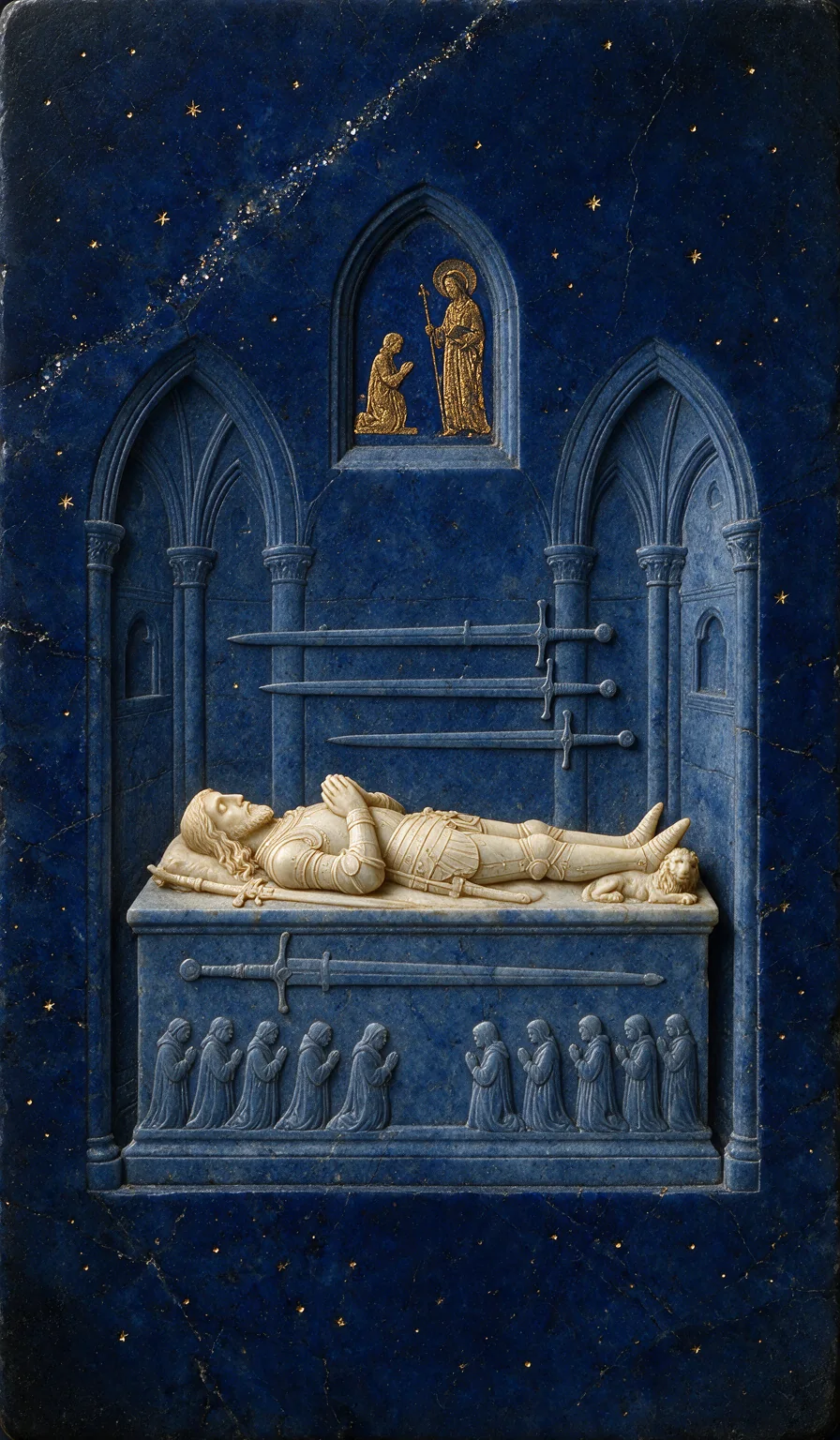
The Four of Swords turns attention toward rest after strain. In Olivia’s deck the scene is a Gothic side chapel carved in lapis: an ivory knight lies on a tomb, eyes closed, hands joined on the chest, the armour still on. This is not an ending but a pause taken in the middle of things. The card commonly follows the hurt of the Three of Swords, and it asks whether the next useful step is not more effort but recovery.
Swords are the suit of Air, of thought, argument and decision, and this card shows the mind choosing to stop. Three lapis swords lie flat and level on the wall above the sleeper, stored rather than raised, and a fourth is carved along the tomb itself. Olivia adds a fifth, in ivory, lying at the effigy’s side within reach but not held. Nothing has been thrown away; it has simply been put down for a while.
Olivia adds two guardians the traditional image does not have: a lion resting at the knight’s feet and a frieze of hooded mourners keeping vigil below. Above them all, the gold niche with its kneeling figure is the brightest thing on the card. Upright, the card invites you to give rest a real shape: a closed door, an agreed hour, a quiet place. Rest does not need to produce an insight to be worthwhile.
Reversed
Four of Swords reversed draws attention to rest that keeps being postponed, or to a retreat that has quietly turned into avoidance. The swords may feel as if they are still in your hands: the mind keeps rehearsing, even in bed, and stillness feels impossible although you are tired. Or the pause has stretched on, and the chapel has become a place to hide rather than recover.
Either way, the card asks for a clearer shape. If rest keeps slipping, protect one small block of time and treat it as seriously as a meeting. If a retreat has lasted longer than it helps, choose one modest, scheduled step back toward the world, rather than waiting to feel fully ready. The lion at the knight’s feet is a reminder that strength is still there.
Read the image
Every element below is carved into this card. Scroll, hover or press a number to follow it on the image.
The gold devotional niche
What you seeHigh in the centre, a pointed niche holds the card’s only gold figures: a haloed standing figure holding an open book and a cross-topped staff, and a smaller figure kneeling before it, palms pressed together.
What it carriesThe traditional image includes a stained-glass window of a kneeling figure before a haloed one, commonly read as blessing or sanctuary for the one who rests. Olivia sets that scene in gold at the centre, so quiet comfort above the sleeper becomes the card’s brightest point.
Follow this symbol through the deck ↗The glittering night vein
What you seeAcross the upper left a diagonal band of pale, sparkling mineral runs through the dark lapis, and small gold stars are scattered above the arches and below the tomb.
What it carriesThe traditional image is set indoors with no sky at all. Olivia lets the night show above and around the chapel, which suits a card of sleep. The mind of the Swords suit belongs to the air and the sky; here it has gone quiet under the stars.
Follow this symbol through the deck ↗Two pointed Gothic arches
What you seeCarved in paler lapis, two pointed arches with ribbed vaults stand left and right on slender clustered columns with leafy capitals; small arched windows are cut into their side walls.
What it carriesThe church setting is traditional for this card: a sheltered, consecrated place where striving is set aside. The paired arches frame the tomb like a side chapel, giving rest a protected space of its own rather than a stolen moment in the open.
Follow this symbol through the deck ↗Three swords on the wall
What you seeThree lapis swords lie horizontally one above another across the back wall, points to the left, hilts to the right with disc pommels and straight crossguards; the lowest is set furthest right.
What it carriesIn the traditional image three swords hang point down above the sleeper, the troubles of the Three of Swords hung up for now. Olivia lays them flat and level, which reads even more like a truce: the weapons are stored, not threatening, and nobody is holding them.
Follow this symbol through the deck ↗The sleeping ivory knight
What you seeAn ivory effigy in full plate armour lies on its back, head on a cushion at the left, long hair spread, eyes closed, hands joined palm to palm on the chest.
What it carriesThe effigy is the heart of this card: a fighter lying still with the armour still on. It is usually read as rest and recovery, not death. Prayerful hands turn the pause into something chosen and tended, a withdrawal made with intention.
The ivory sword alongside
What you seeAn ivory sword lies along the front edge of the slab: pommel beyond the cushion, curled crossguard just below the head, blade running beneath the bent arm. A shorter sheathed blade hangs at the hip.
What it carriesThe traditional image has four swords; Olivia adds this fifth, carved in the same ivory as the figure. Kept within reach but not held, it reads as a capacity set aside rather than surrendered, ready for the return once rest has done its work.
Follow this symbol through the deck ↗The lion at the feet
What you seeAt the right end of the slab a small maned ivory lion lies with forepaws stretched out and head turned toward the viewer, the effigy’s pointed armoured feet resting just above it.
What it carriesThe traditional tarot image has no lion. On medieval tombs a lion at the feet commonly stood for courage and steadfastness. Olivia adds it as a quiet guardian: strength does not vanish during rest, it lies down and keeps watch.
Follow this symbol through the deck ↗The sword on the tomb
What you seeCarved in lapis along the front of the tomb chest, a long sword lies horizontally with its disc pommel and crossguard at the left and its point toward the right.
What it carriesIn the traditional image one sword lies along the side of the tomb beneath the resting figure. Here it points the opposite way to the three on the wall, so the carved lapis blades answer each other across the chapel: a small balance that holds the rest steady.
Follow this symbol through the deck ↗Ten hooded mourners
What you seeBelow the tomb sword a frieze of hooded, robed figures with hands joined runs along the chest in two groups of five, each group turned toward the centre, a gap between them.
What it carriesThese weepers are Olivia’s addition, borrowed from Gothic tomb carving, where rows of hooded mourners keep vigil. They suggest that rest is held by others too: a quiet company keeping watch so the sleeper does not have to.
The number
Four is the number of structure and stability: four walls, four corners, a table that stands on four legs. After the single point of the Ace, the tension of the Two and the sorrow of the Three, the Four builds a steady base. In the suit of Swords, where Air and thought rarely sit still, that stability looks like a mind at rest. The Four of Swords is a consolidation, a pause that lets understanding settle before the movement of the Five.
The tradition
In the Golden Dawn system the Four of Swords is titled the Lord of Rest from Strife. It is assigned to Jupiter in Libra, the third decan of that sign (20 to 30 degrees), and to Chesed, Mercy, the fourth Sephirah on the Tree of Life, expressed through the suit of Air. Jupiter’s generosity on Libra’s scales is commonly read as a truce, balance restored after the sorrow of the Three; Aleister Crowley’s Thoth deck shortened the title to Truce. Marseille decks show only four curved blades interlaced around a small flower. Pamela Colman Smith’s 1909 design turned the card into an effigy on a tomb inside a church, with three swords hanging above, one along the tomb and a stained-glass window.
Love, work and self
- Love
- In close relationships the Four of Swords can point to a need for breathing space: a pause in a heated conversation, an evening without problem-solving, or time alone that is not a rejection. It does not tell you what another person feels. It asks whether a short, agreed truce would help more than another round of talking. With yourself, it invites gentleness: the lion at the knight’s feet rests too, and care can be quiet.
- Work
- At work or in study, this card often appears when effort has stopped paying off: rereading the same page, rewriting the same email. It invites a deliberate interval, a real break, a lighter week, or stepping back from a decision until your head is clearer. Swords like to keep fighting, so name when you will return. Where money or practical matters are involved, a pause to gather information can be wiser than acting while exhausted.
- Self
- For your relationship with yourself, the Four of Swords asks what rest actually looks like for you, beyond stopping work. Notice what the effigy’s posture suggests: lying down, closing the eyes, hands at peace, the sword put aside. Sleep, silence, prayer, meditation or a slow walk can all be forms of this card. Notice, too, whether you allow rest only once you have earned it, and what would change if you did not.
In a spread
Read the card through each position before you look at Olivia’s version. A position is a question, and the same card answers each one differently.
The situation
What aspect of the situation deserves attention?
Olivia’s readingAt the centre of a question, the Four of Swords points to tiredness that may lie beneath the surface. Recovery could be the real issue, and a pause may help more than any new plan.
What complicates it
What tension or assumption deserves a closer look?
Olivia’s readingAs a challenge, the card can show a mind that will not lay its swords down, or a retreat that has lasted so long it has begun to feel safer than returning.
A helpful next step
What small action could help you understand or respond?
Olivia’s readingAs advice, it invites you to schedule a genuine pause, protect it from interruption, and decide in advance when and how you will pick things up again.
In conversation with
- Four of Swords + Three of Swords
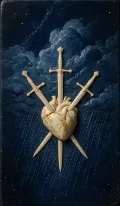
With the Three of Swords the pair traces a sequence: a hurt is felt, then rested. Together they ask whether you have given yourself time to recover after something painful, or rushed straight back into the fight.
- Four of Swords + The Hanged Man
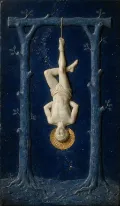
The Hanged Man also shows a figure deliberately still. Beside the Four of Swords the two cards draw attention to a pause that changes perspective, a surrender of effort that lets something new come into view.
- Four of Swords + Four of Cups
The Four of Cups shows a figure withdrawn and turned inward. Next to the Four of Swords the two fours ask whether your stepping back is nourishing rest or a quieter kind of disengagement that needs noticing.
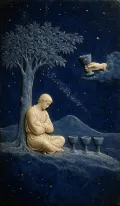
Questions to keep
- Which sword are you still holding that could safely be laid on the wall for now?
- What would a pause look like if you gave it a clear beginning and end?
- Who or what keeps watch for you while you rest, like the lion and the mourners?
Ask them with three cards ↗A three-card reading in which each position asks one of these questions.
A small practice
Set a timer for ten minutes, lie down or sit still with your eyes closed, and let each thought pass without following it until the timer ends.
Cards that share its symbols
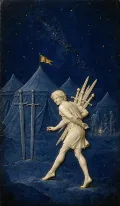 Seven of SwordsShares: Three swords on the wall · Ten hooded mourners · The glittering night vein
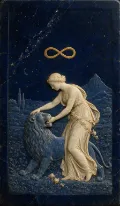 StrengthShares: The glittering night vein · The lion at the feet
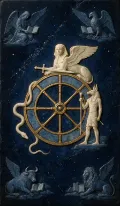 Wheel of FortuneShares: The glittering night vein · The lion at the feet
 JusticeShares: The glittering night vein · Three swords on the wall