Minor Arcana · Wands
Two of Wands
Tarot card meaning: upright, reversed and the symbols of the Olivia image
The Two of Wands holds the moment after the spark: you know what you want, and you stand on familiar ground deciding how far to reach.
- Upright
- planningwider viewfirst decisionpersonal authoritychoosing direction
- Reversed
- untested plansfear of leavingrestlessnessnarrow horizonhovering
Upright
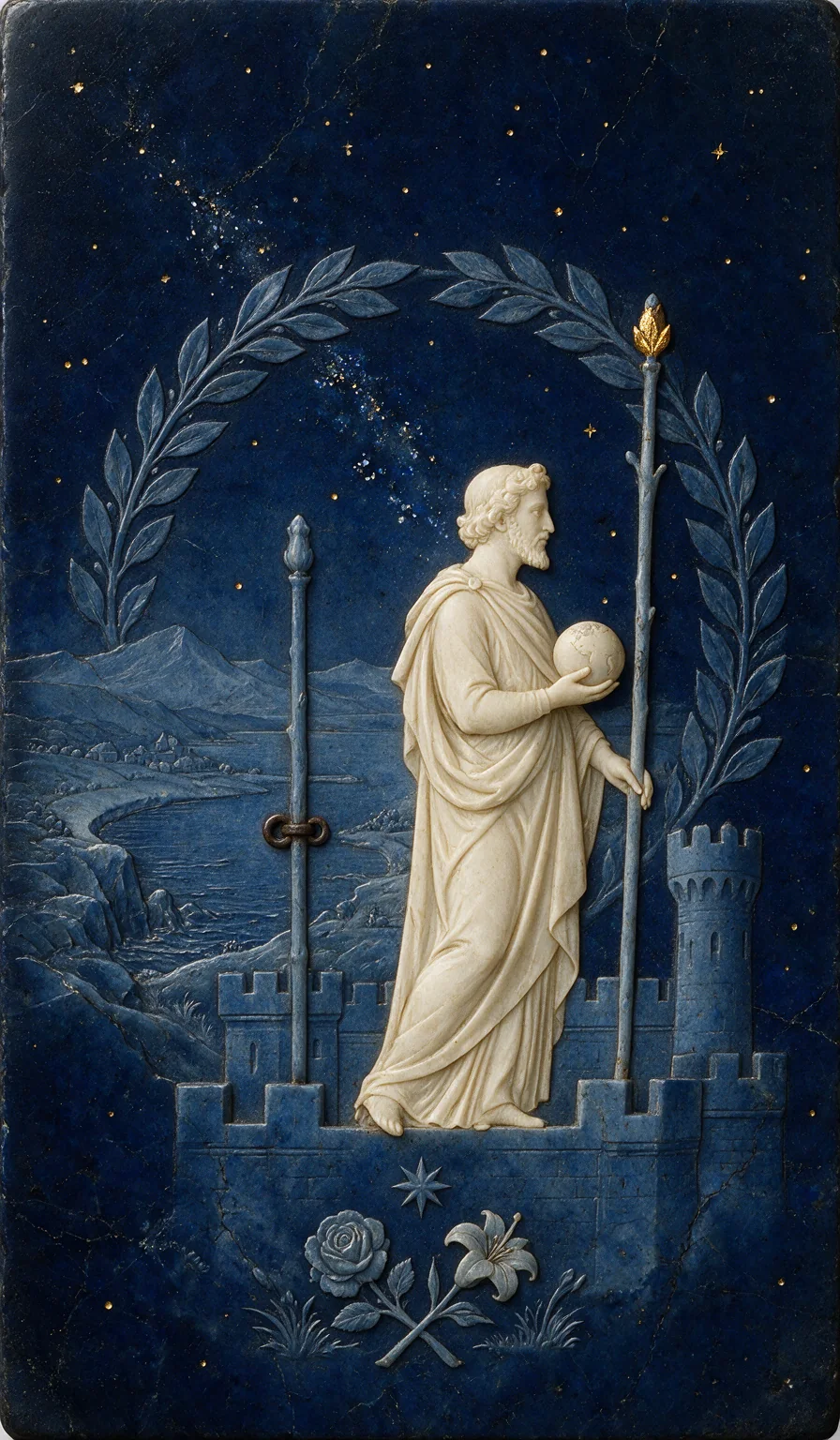
The Two of Wands is the pause between having an idea and acting on it. The Ace gave you a spark; the Two asks what you will do with it now that you can see further. In Olivia’s deck an ivory figure stands barefoot on the battlements of a blue lapis wall, a small globe resting in one palm, the other hand closed around a tall wand. Behind the figure a bay opens between cliffs, with a village and mountains beyond.
Look at the two wands. The one on the left is fastened in place by a clasp of iron rings, its bud still shut. The one the figure holds is knotted and alive, and at its tip a bud has opened in gold. What is already secured matters: your home ground, your skills, the commitments you have made. But the new growth is in the wand you are holding. The globe says the same thing more quietly: the world sits in your hand as a plan, small enough to turn and study.
Upright, the card invites deliberate choice rather than restless leaping. It can point to some authority over your next step, and room to think it through. Take stock of what you hold, look honestly at what lies beyond the wall, and decide which direction deserves your fire. You can explore a path before committing to all of it.
Reversed
Two of Wands reversed can point to a plan that stays in the palm, turned over and over but never tested. The walls feel safer than the view, and the fixed wand starts to look like the only one. Or the opposite may be true: impatience with the battlements, a wish to be anywhere but here, before you know where there is.
This position asks for one small experiment rather than a grand decision. Find out one practical thing about the direction you keep circling: a cost, a date, a person you could ask. A clearer view does not oblige you to leave what you know; it lets you choose instead of hover.
Read the image
Every element below is carved into this card. Scroll, hover or press a number to follow it on the image.
The gold-budded wand
What you seeThe taller wand, on the right, is a knotted staff of grey-blue lapis with small side shoots. At its tip a bud opens in gilded leaves, the only gold beyond the scattered stars.
What it carriesWands are the suit of Fire: will, desire and creative drive, and a leafing staff is that fire still growing. Of the two wands, only the one in the figure’s grip has begun to open, and in gold. The live energy is in what you are actually holding.
Follow this symbol through the deck ↗Two arching laurel branches
What you seeTwo leafy branches carved in pale grey-blue lapis rise on either side of the scene and bend inward over it, their tips drawing close above the figure’s head without joining.
What it carriesLaurel has long crowned victors and poets, and it is not part of the traditional Two of Wands. Olivia sets it as an unfinished arch: recognition is sketched around the figure but not closed. At this stage success is imagined, not yet won.
Follow this symbol through the deck ↗The level gaze
What you seeThe ivory figure, with curling hair and beard, stands in strict profile facing right. The eyes look level and outward, above the globe, towards the shaft of the held wand, while the bay lies behind the shoulders.
What it carriesWaite described the figure looking out over sea and shore. Olivia turns the figure away from the view and towards the held wand. The surveying has been done; attention now rests on your own means and the choice of what to do with them.
The small ivory globe
What you seeAt chest height one hand cradles a smooth ivory globe from beneath, fingers curled around its lower curve. Faint incised lines of coastlines and continents run across its surface.
What it carriesThe globe is this card’s traditional emblem of reach: the whole world made small enough to hold. It stands for a plan rather than a territory. Resting in the palm while the real landscape lies behind, it asks whether you are studying the map or the ground.
Follow this symbol through the deck ↗The wand fixed in rings
What you seeThe left wand, slimmer and shorter, with small knots along its shaft and a closed bud at its tip, rises from the wall. About halfway up it is held by a clasp of two dark, rust-brown rings joined across the shaft.
What it carriesWaite noted that one staff is fixed in a ring, and it is often read as what is already secured: home ground, past effort, a commitment made. Here its bud stays closed and grey. That security is real, but the new growth is elsewhere.
Follow this symbol through the deck ↗The bay and far shore
What you seeTo the left, in lighter blue lapis, a curved bay opens between rocky cliffs, with a cluster of small houses on the far slope and a range of mountains beyond.
What it carriesSea and land are the dominion this card traditionally surveys: the world beyond your walls, reachable but not yet entered. Olivia carves it in soft, shallow relief behind the figure, a place already seen and weighed rather than one being walked into.
Follow this symbol through the deck ↗Battlements and round tower
What you seeThe barefoot figure stands on crenellated walls of blue lapis, built in two tiers with a small square turret on the left. On the right they end in a round tower with a corbelled, crenellated top and narrow slit windows.
What it carriesBattlements are the traditional setting of the Two of Wands: a height built and held, from which you can see far. It gives perspective and also distance. The wall that keeps you safe is the same ledge you would have to leave in order to act.
Follow this symbol through the deck ↗The eight-pointed star
What you seeCarved into the face of the wall just below the figure’s bare feet, a small eight-pointed star in pale grey-blue lapis sits directly above the crossed flowers.
What it carriesThe star is Olivia’s addition rather than part of the traditional card. Its eight points recall the gold star that leads Olivia’s Fool. Set in the wall itself, it suggests that a plan begins as an orienting light, long before it becomes a route.
Follow this symbol through the deck ↗The crossed rose and lily
What you seeBelow the star, a full-blown rose in grey-blue lapis and an open lily in a paler, almost ivory tone are carved in relief, their leafy stems crossing in an X, with tufts of grass on either side.
What it carriesWaite asked readers to notice a rose, cross and lily on this card. The pairing recalls the Magician’s garden, commonly read as desire joined to pure intention. Here the crossed stems themselves make the cross, set at the centre of the wall’s foot: the plan above rests on both.
Follow this symbol through the deck ↗
The number
Two is the first relationship: one thing set beside another, and so the first choice. In the Minor Arcana the Ace offers raw potential, and the Two gives it direction by placing it against something already there. In Wands, the suit of Fire, will and creative drive, this becomes a question of intention. The spark of the Ace now stands beside the known world, and you weigh the familiar against the possible. The Two plans; the Three that follows watches its ventures set out.
The tradition
In the Golden Dawn system the Two of Wands is titled the Lord of Dominion. It is assigned to Mars in Aries, the first decan of that sign (0 to 10 degrees), and to Chokmah, Wisdom, the second Sephirah on the Tree of Life, expressed through the suit of Fire. Mars was the traditional ruler of Aries, so this decan doubles its fire: initiative at the very start of the zodiac. Aleister Crowley kept the single title Dominion. Marseille decks show two long batons crossed among stylised foliage. Pamela Colman Smith’s 1909 design gave the card its scene: a figure on battlements holding a globe, one staff in hand and another fixed in a ring.
Love, work and self
- Love
- In close relationships the Two of Wands can point to a moment of deciding what you want a bond to become, rather than letting it drift. The card cannot tell you what anyone else intends. It invites you to hold your own wish the way the figure holds the globe: look at it clearly, then decide whether and how to say it. With yourself, it can mean making room for a desire you have kept safely fixed in place for a long time.
- Work
- At work or in study, this card often appears when a plan is ready in outline: a project, a course, a move towards a new role or field. Your ground is secure enough to think from. The task now is to test the plan against reality: list what you already hold, what you would need, and what you still do not know. Where money, contracts or large commitments are involved, check the details with a qualified person before you step off the wall.
- Self
- For your relationship with yourself, notice the difference between the two wands. One is fastened in iron and closed; the other is in your hand and opening in gold. Some parts of your life are rightly settled and need no more of your grip. Others are still growing and ask for attention. The card invites you to name which is which, and to give today’s energy to the living one.
In a spread
Read the card through each position before you look at Olivia’s version. A position is a question, and the same card answers each one differently.
The situation
What aspect of the situation deserves attention?
Olivia’s readingAt the centre of a question, the Two of Wands can point to a plan that may already be in your hand: perhaps a direction you have imagined, waiting for you to choose it deliberately and begin.
What complicates it
What tension or assumption deserves a closer look?
Olivia’s readingAs a challenge, the card can show a vantage point that has become a waiting room: studying the map, weighing options without end, or feeling safer behind the wall than testing an idea.
A helpful next step
What small action could help you understand or respond?
Olivia’s readingAs advice, the card invites you to survey what you have, notice which wand you are really holding, and take one measured step towards the view.
In conversation with
- Two of Wands + The Emperor
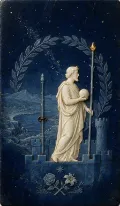
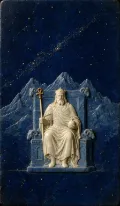
With The Emperor, the Major Arcana card of Aries in the Golden Dawn system, the Two’s private plan meets structure and authority. Both figures cradle a small orb from beneath; together they draw attention to turning a personal vision into a steady, well-kept order.
- Two of Wands + The Magician
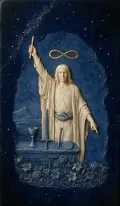
Paired with The Magician, whose garden of roses and lilies echoes the flowers carved on this wall, the Two’s vision gains its means. The Magician has the tools laid out; the Two decides where to point them.
- Two of Wands + Three of Wands
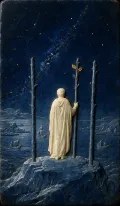
With the Three of Wands, the next step of the suit, planning turns into launching. The Two stands on its own walls deciding; the Three looks out at ships already on the water. Together they ask how long you have been planning, and what is ready to leave.
Also read withAce of WandsAll pairs ↗
Questions to keep
- What are you holding in your palm right now that you have not yet tested against the world?
- Which parts of your life are rightly fixed in place, and which are still growing?
- What would you want to know before stepping beyond familiar ground?
Ask them with three cards ↗A three-card reading in which each position asks one of these questions.
A small practice
Draw two columns headed “secured” and “growing”, list what belongs in each, then circle one growing item and write the smallest step that would test it this week.