Major Arcana · XIV
Temperance
Tarot card meaning: upright, reversed and the symbols of the Olivia image
Temperance is the patient art of mixing: bringing two different things into a workable blend, one measured pour at a time, and adjusting as you go.
- Upright
- balancemoderationblendingpatiencehealingright measure
- Reversed
- excessimbalanceimpatienceovercorrectinginner recalibration
Upright
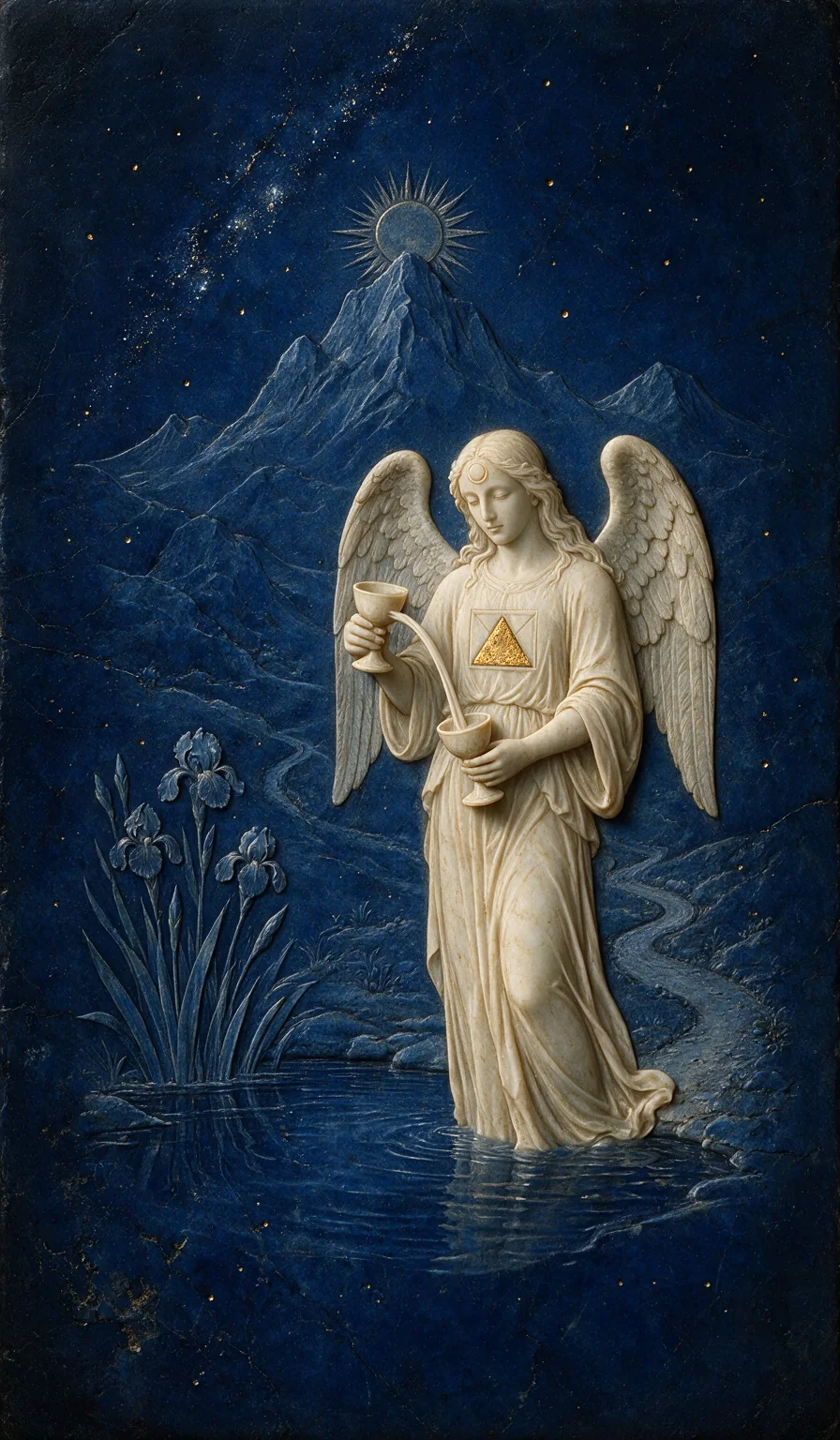
Temperance draws attention to proportion and pace. Look at how carefully the figure works: one ivory goblet is held high and tilted, and a smooth stream arcs down into a second goblet held near the waist. The eyes are lowered, following the flow. Nothing is spilled and nothing is hurried. The card invites you to treat balance as an activity rather than a fixed state, something made by pouring, noticing and pouring again.
The pouring is commonly linked with tempering wine with water: two substances mixed until neither overwhelms the other. Where in your life are two needs, moods or commitments asking to be blended rather than ranked? Temperance does not ask you to split everything evenly. It asks what mixture actually works here, and invites small experiments: a little more rest, a little less pressure, a conversation held at a gentler speed.
Olivia sets this quiet work between water and shore. The figure stands in a rippled pool while the hem of the robe reaches the stony bank, and a winding path leaves that bank for the hills beneath a pale sun resting on the highest peak. The road bends many times. Healing, recovery and integration often look like this: many modest corrections that gradually add up to steadiness.
Reversed
Temperance reversed points to a mixture that has lost its measure. You may be pouring too much into one cup, whether work, worry, pleasure or care for others, while the other runs dry, or swinging between extremes as you try to correct. Impatience is common here: wanting the blend to settle at once, and abandoning it when it does not.
The reversed card can also describe balance being rebuilt inwardly, out of sight. Rather than a dramatic fix, it invites one small adjustment you can observe for a week. Ask which vessel needs refilling first, and what pace would let the stream between them run smoothly again.
Read the image
Every element below is carved into this card. Scroll, hover or press a number to follow it on the image.
The stream between two goblets
What you seeThe figure holds a stemmed ivory goblet high on the viewer’s left and tilts it; a smooth ivory stream arcs down into a second goblet held lower, near the waist, in the other hand.
What it carriesPouring between two vessels is the card’s oldest feature, commonly linked with the ancient habit of tempering wine with water. It is not about emptying one cup to fill another but about mixing in a continuous, deliberate flow. The lowered eyes follow the stream closely, as though the measure matters.
Follow this symbol through the deck ↗The gold triangle in a square
What you seeOn the breast of the robe a raised square panel is outlined in ivory, with thin lines running inward from its upper corners. Inside it stands an upward-pointing triangle in gold, the largest area of gold on the card.
What it carriesThe square and triangle belong to the traditional design: the square is commonly read as the four elements of the material world, the upward triangle as spirit or fire, and together three and four make seven. Olivia gives this sign the card’s gold: spirit held within ordinary form.
The disc on the brow
What you seeAt the hairline, above the centre of the brow, sits a small round ivory disc inside a raised rim that thickens along its lower left edge, so it reads almost as a crescent cradling a disc. The eyes beneath are lowered.
What it carriesThe traditional figure wears a sign of the sun on the forehead, often read as awareness held steady at the centre of the self. Here the disc sits within a crescent-like rim, suggesting sun and moon held together, a fitting sign for a card about blending two things into one.
Follow this symbol through the deck ↗The raised ivory wings
What you seeTwo large ivory wings rise behind the shoulders, their upper curves level with the head and their long flight feathers falling to about hip height, carved feather by feather against the blue ground.
What it carriesTemperance is traditionally drawn as an angel, a go-between linking what is above with what is below. The traditional wings are often coloured red; Olivia keeps them the same ivory as the robe, so the whole being reads as one calm, even substance with nothing flaring or urgent.
Follow this symbol through the deck ↗The sun on the peak
What you seeAbove the tallest mountain a round disc of grey-blue lapis with a fine pale rim rests on the summit, its lower edge hidden by the rock, ringed with alternating long and short pointed rays.
What it carriesIn the traditional image a path climbs from the pool towards a light between two peaks, commonly read as the goal of patient inner work. Olivia sets the light on a single summit and carves it in cool grey-blue lapis rather than gold: a quiet dawn at the end of a long road rather than a blaze.
Follow this symbol through the deck ↗The winding path
What you seeFrom the stony bank at the right of the pool a pale, finely textured path winds up the slope and disappears behind the figure. A thinner winding line crosses the slopes on the left, beside the irises.
What it carriesThe path from the water to the heights is a classic feature of Temperance, commonly read as the long road of gradual integration. It bends back and forth rather than climbing straight, a reminder that balance is reached adjustment by adjustment, not in one decisive leap.
Follow this symbol through the deck ↗The irises at the water’s edge
What you seeAt the left, carved in lighter blue lapis, a clump of irises grows beside the pool: three open blooms on tall stems, several closed buds and long blade-shaped leaves rising from the bank.
What it carriesIrises are part of the traditional scene and are linked with Iris, the Greek messenger of the rainbow who travelled between sky and earth, echoing the angel’s role as mediator. Olivia carves them in the blue of the night, so they belong to the landscape rather than decorate it.
Follow this symbol through the deck ↗The rippled pool
What you seeThe figure stands in a dark pool, robe falling straight into the water, feet hidden. Rings of ripples spread outward from the hem, and a trailing fold sweeps out to touch the stony bank at the right.
What it carriesThe traditional angel stands with one foot in water and one on land, a picture of feeling and practical life held together. Olivia hides the feet: the figure stands in the water while the hem reaches the shore, so the contact with both is softer and continuous.
Follow this symbol through the deck ↗The band of stars
What you seeAcross the upper left of the night sky a diagonal band of tiny pale and silvery chips runs down from the top edge, among scattered gold star flecks set into the lapis.
What it carriesThe starry band is Olivia’s addition, not part of the traditional card. It gives the quiet mixing below a much larger counterpart: a slow river of light across the sky, as if the same careful blending were happening at every scale.
Follow this symbol through the deck ↗
The number
Temperance is card XIV, following Death and preceding The Devil. Fourteen is twice seven, and when the Major Arcana are laid out in three rows of seven it closes the middle row, often read as the row of inner work. In the Fool’s journey, after Death has cleared away an old form, Temperance is the slow mixing that lets something new take shape. The step asks for patience: to combine what remains into a steadier balance before meeting the excesses of card XV.
The tradition
In the Golden Dawn system Temperance is Atu XIV, titled “The Daughter of the Reconcilers, the Bringer-forth of Life”. It is assigned the Hebrew letter Samekh, meaning prop or support, and the sign Sagittarius, mutable Fire, on the path joining Yesod and Tiphareth on the Tree of Life. Temperance was one of the four cardinal virtues, and early Italian cards such as the Visconti-Sforza deck show a woman pouring liquid between two vessels; Marseille decks gave the figure wings. Pamela Colman Smith’s 1909 design set the angel with one foot on land and one in water, with a square and triangle on the breast, irises, and a path rising towards a light between the mountains.
Love, work and self
- Love
- In close relationships Temperance draws attention to rhythm and give-and-take: how much closeness and how much space, how much you speak and how much you listen. It does not ask either person to disappear into the other; it asks what blend lets both stay themselves. After tension, it can point to repair made slowly, one honest exchange at a time. With yourself, it invites the same patience you would offer someone you love.
- Work
- At work or in study, Temperance favours steady pacing over bursts followed by collapse. It can point to combining two methods, roles or disciplines into something more useful than either alone, or to a team where different strengths need mixing rather than competing. With money matters, it suggests calm, moderate habits and gradual review rather than swings between strict control and letting everything go.
- Self
- For your own wellbeing, Temperance asks where you run hot and cold: all effort then none, strict rules then no rules at all. The figure in the pool belongs to neither water nor shore alone, and the path behind it winds rather than climbs straight. Notice one area where a gentler, more consistent measure might steady you, and try it as an experiment you can keep adjusting.
In a spread
Read the card through each position before you look at Olivia’s version. A position is a question, and the same card answers each one differently.
The situation
What aspect of the situation deserves attention?
Olivia’s readingAt the centre of a question, Temperance suggests the real subject is proportion: not which option to choose, but how to combine what matters in a mixture you can sustain.
What complicates it
What tension or assumption deserves a closer look?
Olivia’s readingAs a challenge, Temperance can point to impatience with a slow process, or to a blend that has tipped too far one way. Something may be overfilled while something else runs low.
A helpful next step
What small action could help you understand or respond?
Olivia’s readingAs advice, Temperance invites one small, measured adjustment: slightly less of one thing, slightly more of another. Try it for a while, observe how it feels, then pour again.
In conversation with
- Temperance + Death
With Death, the card before it, an ending is followed by patient recombining. Together they suggest giving a change time to settle, then slowly mixing what remains into a new balance rather than rushing to replace what has gone.
- Temperance + The Devil
With The Devil, the card after it, measure meets excess. Together they draw attention to where a healthy blend tips into dependence or compulsion, and what small act of moderation might loosen the pull.
- Temperance + The Star
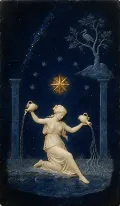
With The Star, both cards show an ivory figure pouring beside a pool. Temperance measures one stream between two goblets; The Star empties two jugs freely, onto water and onto land. Together they ask which kind of replenishment you need now: careful mixing or open release.

Also read withEight of WandsTwo of CupsAll pairs ↗
Questions to keep
- Which two needs in your life are asking to be blended rather than ranked?
- Where are you pouring too much from one cup, and what is running low?
- What small adjustment could you try this week and simply observe?
Ask them with three cards ↗A three-card reading in which each position asks one of these questions.
A small practice
Pour water slowly from one glass into another three times, noticing your breath each time, then write down one area of life that needs a gentler pace.