Asking and looking · Lesson 2 of 5
Describe before you interpret
Say plainly what a card shows, where it sits and what the figure does, before you say what it means, so your readings rest on the artwork itself.
Meaning arrives too early
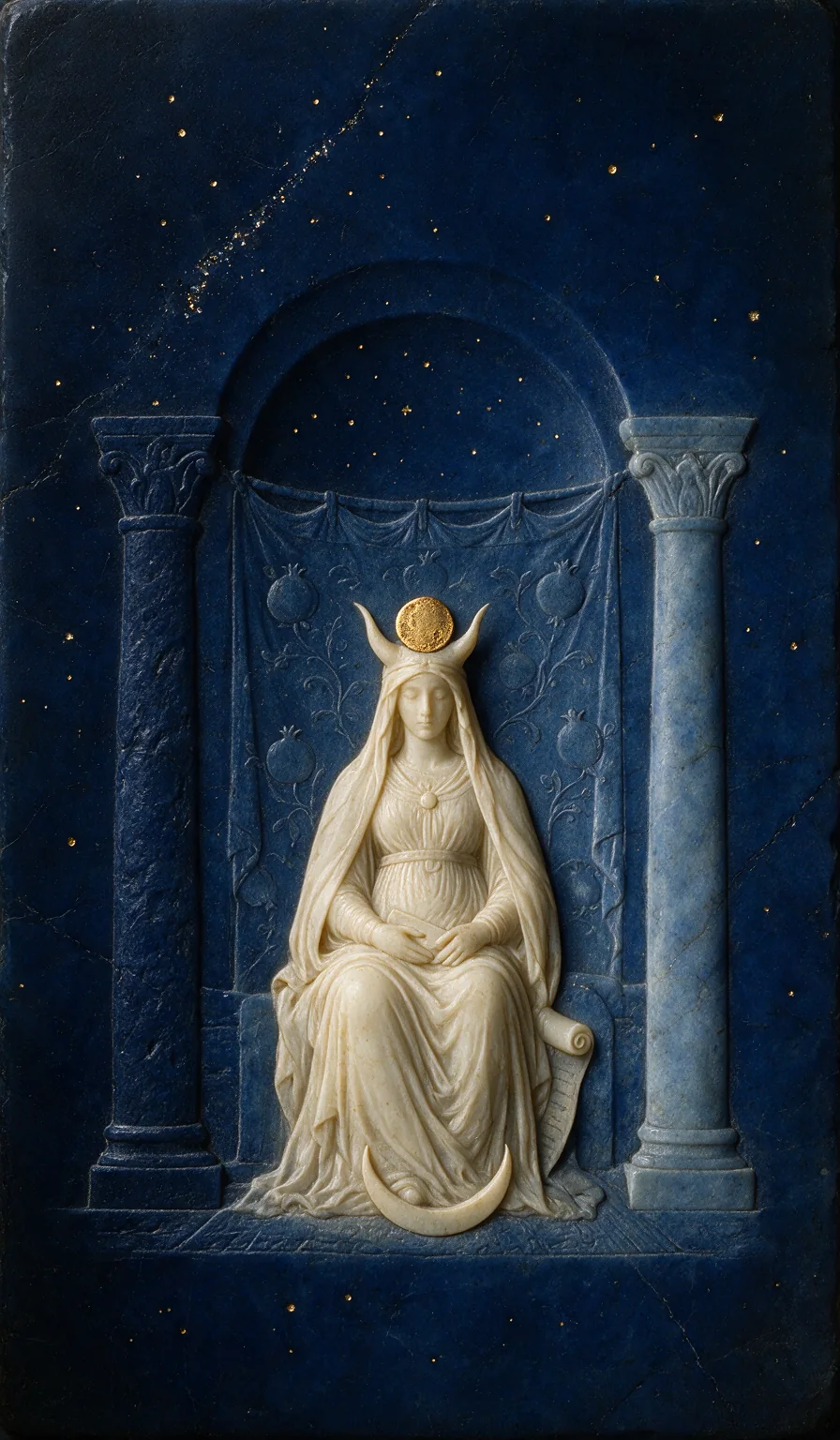
Draw The High Priestess and a word usually arrives before your eyes have settled: intuition, secrets, the unconscious. The word is not wrong, but it is someone else’s looking, remembered. It turns up the same way whatever the deck and whatever the question, and it closes the card before you have opened it.
This lesson reverses the order. First say plainly what is there. Only then ask what it might mean. The pause is short, a minute or two, and it changes what you have to work with: instead of a keyword, you hold a picture you have actually seen, full of details that can meet your question in ways a keyword cannot.
Three plain questions
A description answers three questions. What is carved? Name things with plain nouns: a crescent, a column, a scroll, a lantern. Where is it? Use the viewer’s left and right, above and below, near and far, so someone else could find it. What is the figure doing? Use verbs of posture and gesture: sits, holds out, rests, looks down.
Leave out words that judge or explain. “Wise”, “lonely”, “hopeful”, “stuck”: these are conclusions, not carvings. A good test is whether someone with the card in front of them could point to what you wrote. “The eyes are closed” passes. “The figure knows a secret” does not. Give a number only when you have counted; otherwise say “several”.
In Olivia’s deck, notice material as well as shape. The figures are carved in ivory against lapis, and gold picks out chosen details. Say what the gold touches, and what it leaves out: in The Hermit, the only carving picked out in gold is the small star inside the lantern.
Keep two columns
On paper, rule a line down the page. On the left, what you see. On the right, what it might mean. Fill the left column first, and fully. Then let each note on the right point back to something on the left. A meaning that points to nothing is a keyword that slipped in unnoticed.
Take The Hermit. The quick reading is solitude and wisdom. The plain lines say something more exact: a hooded figure in profile, facing left, eyes cast downward past the outstretched hand; a lantern held out at chest height with a small gold star inside; a staff whose tip rests near the lip of a pale ledge; below the ledge, a sheer drop into night. Loneliness is not carved. The edge is. Now the meaning has somewhere to stand: attention on the next step, a light for a short distance, ground tested before weight follows.
What looking gives you
Description catches the places where this deck departs from the one in your memory. The traditional High Priestess looks straight out; Olivia’s has closed eyes. The Waite-Smith pillars carry the letters B and J; here they are unlettered, and only their stone tells them apart. Read from keywords and you miss both. These departures are often where a reading comes alive, because you had to notice them yourself.
It also changes how a reading sounds to another person. “The figure’s eyes are closed” is something they can check and answer. They may see what you missed. A description invites them in; a pronouncement keeps them out. It leaves the person, not the card, as the authority on what the picture means for their life.
Walk the pins
The Look first exercise on this page turns this into practice. The High Priestess opens as bare art and you write up to three plain lines. Then the pins appear one at a time, each with what is carved there, and only after that what it has been read to mean. The next time the card comes up, the pins you passed over glow faintly with one question: what do you see now? There is no score.
Away from the screen the drill is simple: ten cards, literal description only, no meanings at all. It feels slow, and the slowness is the point: each card described this way hands you details that no keyword supplied.
Interactive
Look first
Choose a card
Try this
- Open The Hermit’s card page, look only at the art, and write three plain lines: what is carved, where it sits, what the figure does.
- Underline any word that judges or explains, such as wise or lonely, and rewrite it as something you could point to.
- Now read the “What you see” line for each pin, and mark one detail you missed and one your lines already caught.
- Only then write one sentence of meaning, and make sure it names a detail from your plain lines.
- For your next ten daily cards, write the plain lines in a paper notebook before you open the card page.
To remember
- First say what is carved, where it sits and what the figure does.
- Every meaning you offer should point back to something you can see.
- Where Olivia’s art departs from memory, look longest; readings often start there.