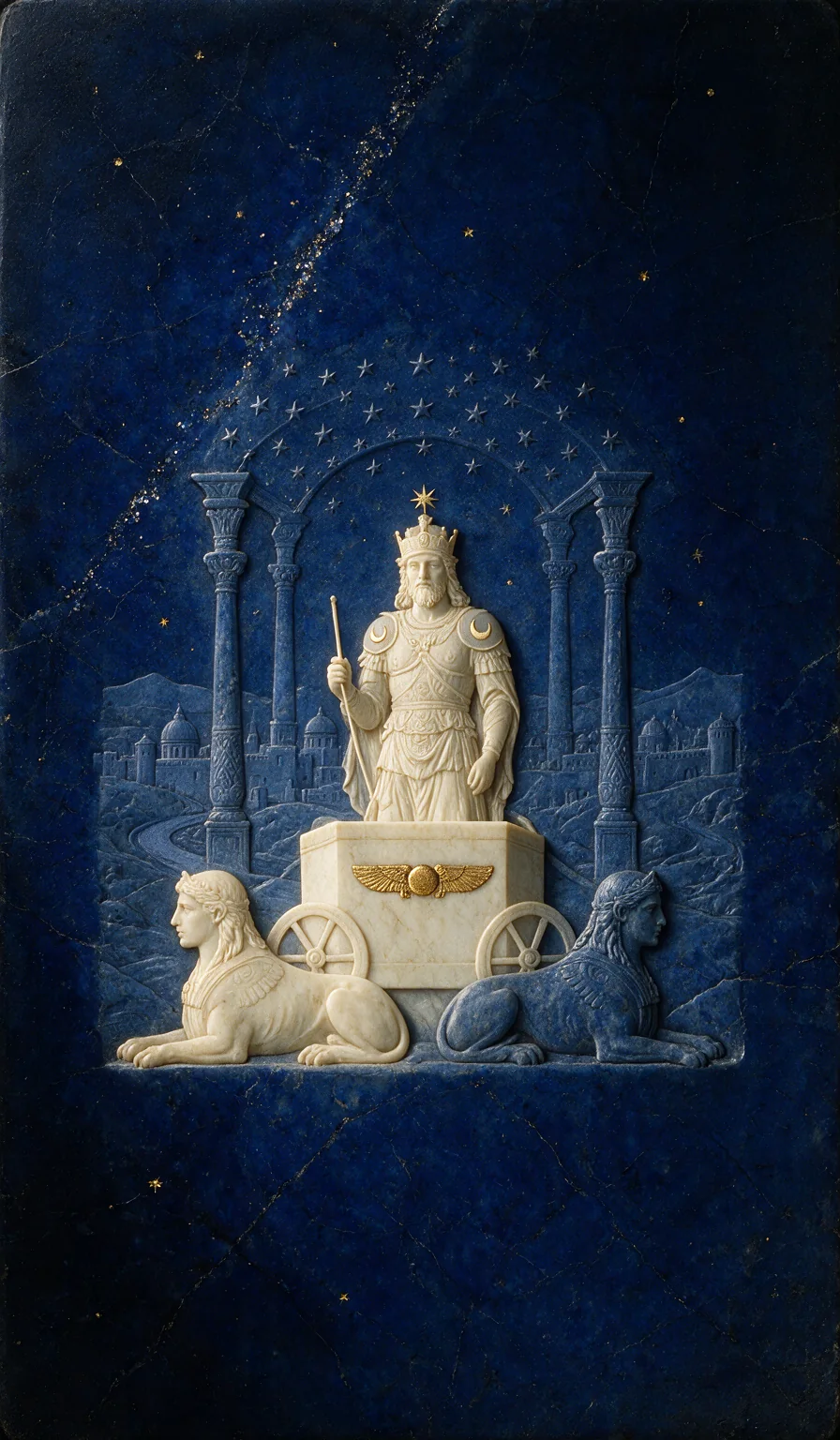
Major Arcana · VII
The Chariot
Tarot card meaning: upright, reversed and the symbols of the Olivia image
The Chariot is will that holds two pulling forces steady and chooses one direction, moving forward by focus and self-command rather than force.
- Upright
- directionwillpowerself-commandfocusmomentumresolve
- Reversed
- scattered effortforcingstalled progressrigid controllost aim
Upright
The Chariot is the card of a decision put into motion. In Olivia’s carving an armoured ivory figure stands upright in a plain chariot under an arch of stars, a gold star rising from the crown, a long staff held in one hand and the other hand empty. There are no reins. What keeps the car on course is not a grip on the animals but the figure’s own steadiness, and that is the heart of the card: direction held from the inside.
Look at what that steadiness has to manage. Below the car two sphinxes lie haunch to haunch, one ivory and one lapis, each gazing outward towards its own side. Neither is harnessed. The card draws attention to the competing pulls in your situation, perhaps two goals, two obligations or two parts of yourself, and asks whether you can hold both in view while choosing a single way forward.
Upright, the Chariot favours focus over speed. The winged gold disc on the car suggests that the drive works best when it serves something worth carrying, and the city left behind shows that moving forward means leaving a familiar place. It can point to a project gathering momentum, a boundary kept, or a commitment you are ready to steer.
Reversed
The Chariot reversed can point to movement without a clear aim, or to control that costs more than it gives. The two sphinxes still look in opposite directions, but no one is holding the line between them: effort goes out in several ways at once and little arrives. The other form is the reverse: gripping so tightly that the armour becomes a shell and every change of route feels like defeat.
Ask which pull has taken over, and what you are trying to control that is not yours to steer. A slower pace, a smaller aim or one honest choice about priorities can let the wheels turn again.
Read the image
Every element below is carved into this card. Scroll, hover or press a number to follow it on the image.
The starry arch
What you seeAbove the charioteer, rows of small pale stars carved in the lapis fan out in an arc over rounded arches. The arches spring from four carved lapis columns, two on each side of the chariot.
What it carriesThe traditional Chariot rides under a starry canopy on four posts, commonly read as the heavens the charioteer answers to. Olivia opens it into an arcade of sky: the vehicle travels under a larger order, with a ceiling of stars rather than a roof.
Follow this symbol through the deck ↗The gold star on the crown
What you seeA small eight-pointed gold star rises from a finial at the centre of the ivory crown. It stands against the lapis just beneath the starry arch, directly above the calm, forward-facing face.
What it carriesA star over the head is commonly read as the aim that steers the will: the charioteer is guided from above the crown, not by the crown itself. In a deck that uses gold sparingly, it crowns the card’s central axis, lined up above the gold disc on the car.
Follow this symbol through the deck ↗Gold crescents on the shoulders
What you seeEach rounded shoulder plate of the ivory armour bears a gold crescent moon, both opening upward. Beneath them the breastplate is worked with fine carved ornament and a belt.
What it carriesCrescents on the shoulder plates belong to the traditional image and tie the card to the Moon and to Cancer, its sign in the Golden Dawn system. They suggest that this armour protects something tender and changeable rather than hiding it: strength shaped around feeling.
Follow this symbol through the deck ↗The staff without reins
What you seeThe charioteer’s hand on the viewer’s left, bent at the elbow, grips a long plain staff with a small rounded knob at the top. The other hand hangs relaxed and empty. No reins appear anywhere.
What it carriesLike the traditional charioteer, this one steers without reins: direction held by will and attention rather than by pulling. The staff is plain, a tool of command rather than decoration, and the empty, relaxed hand on the other side shows control that does not clench.
Follow this symbol through the deck ↗The walled city behind
What you seeBehind the columns, domed buildings, towers and walls are carved in paler lapis on both sides, with hills beyond. On the left a broad road curves out from the city in a long bend towards the chariot.
What it carriesIn the traditional image a walled city stands behind the Chariot: the settled life the traveller has left, or the ground already won. Here it lies behind on both sides, so the card faces forward, away from everything familiar, along the curving way out.
Follow this symbol through the deck ↗The winged gold disc
What you seeAcross the front of the plain, angled ivory chariot body, a gold disc spreads two long feathered wings, with two small shapes hanging beneath it. It is the largest gold element on the card.
What it carriesThe winged sun disc is an Egyptian emblem of protection and divine rule, and a winged globe marks the front of the traditional Chariot too. Olivia gives it the largest share of the card’s gold: the vehicle is carried by a purpose that is lifted and bright.
Follow this symbol through the deck ↗Two spoked wheels
What you seeTwo ivory wheels with raised hubs and straight spokes sit at the lower corners of the veined ivory car, their lower rims just behind the crouching sphinxes. Nothing is harnessed to them or pulling them.
What it carriesWheels are the card’s capacity for motion, yet here the chariot stands still on a ledge. The traditional Chariot is also often read as poised rather than racing: movement available and gathered, waiting for a decision about which way to go.
Follow this symbol through the deck ↗The ivory sphinx
What you seeOn the left, an ivory sphinx lies with forepaws stretched out and tail curled round its haunch, a small wing carved on its shoulder and a wreath in its hair. Its face turns outward, left.
What it carriesEliphas Lévi replaced the Chariot’s horses with two sphinxes, one light and one dark, and the Waite-Smith card kept them. The light sphinx is commonly read as one of two opposing drives: here it looks firmly away from its partner, towards its own side.
Follow this symbol through the deck ↗The lapis sphinx
What you seeIts twin on the right is carved from blue lapis in the same crouching pose, almost a mirror image, with a leafy band in its hair and its face turned outward to the right, away from the other.
What it carriesTraditionally the second sphinx is black; Olivia carves it from the same blue stone as the ground and the night. The two face opposite ways with nothing binding them to the car, so holding them together is left entirely to the figure standing above.
Follow this symbol through the deck ↗
The number
The Chariot carries seven, the last card of the first row if the Major Arcana is read in three rows of seven. The Fool has met the Magician’s skill, the High Priestess’s inner knowing, the ordering of Empress, Emperor and Hierophant, and made a personal choice in the Lovers. Seven is where all of this becomes movement: the traveller leaves home in a vehicle of their own making. It asks you to act on what you have chosen.
The tradition
In the Golden Dawn system the Chariot bears the title “The Child of the Powers of the Waters; the Lord of the Triumph of Light”. It is attributed to Cheth, the Hebrew letter often glossed as a fence or enclosure, and to the sign of Cancer, whose crab carries its armour as a shell; it occupies the eighteenth path of the Tree of Life, joining Binah and Geburah. Early Italian decks such as the Visconti-Sforza show a triumphal car drawn by horses. Eliphas Lévi replaced the horses with a white and a black sphinx, and Pamela Colman Smith kept them in 1909. Olivia turns the pair to ivory and lapis.
Love, work and self
- Love
- In love and close bonds, the Chariot asks what you are steering towards together, and whether both of you are facing the same way. Like the two sphinxes, people in a relationship can pull in different directions without either being wrong. The card favours clear, kind intention over pressure: saying what you want, keeping a boundary, choosing a shared next step. With yourself, it invites you to notice when your armour protects you and when it keeps closeness out.
- Work
- In work and study, the Chariot supports focused effort towards a named goal: a deadline, an application, a project that has been circling without landing. It asks you to pick the direction first and let speed follow. Notice where two priorities are cancelling each other out and decide, for now, which one leads. With money matters, the card points to discipline and a clear plan; any decisions still deserve careful checking of the details.
- Self
- For your own growth, the Chariot turns attention to self-command: the capacity to feel competing wishes and still act on what matters most. The figure in the carving is calm, one hand holding the staff, the other empty and relaxed. Consider where you steer by clenching and where you could steer by attention instead. Self-discipline here is not harshness; it is loyalty to a direction you have chosen for good reasons.
In a spread
Read the card through each position before you look at Olivia’s version. A position is a question, and the same card answers each one differently.
The situation
What aspect of the situation deserves attention?
Olivia’s readingAt the heart of a question, the Chariot suggests the real issue is direction: two forces pulling apart and a choice about which one leads. What matters is steering, not speed.
What complicates it
What tension or assumption deserves a closer look?
Olivia’s readingAs a challenge, the Chariot can point to effort split between competing aims, or to a grip so tight that it leaves no room to adjust the route when the ground changes.
A helpful next step
What small action could help you understand or respond?
Olivia’s readingAs advice, the Chariot invites you to name one direction, hold it steadily for a set time, and let the other pulls wait their turn without pretending they are gone.
In conversation with
- The Chariot + The Lovers
The Lovers make a choice; the Chariot puts it into motion. Together they draw attention to whether a decision has actually been acted upon, or is still being weighed while nothing moves.
- The Chariot + Strength
Both cards are about mastering a powerful force. The Chariot steers it through will and focus; Strength calms it through patience and gentleness. Together they ask which kind of mastery the moment needs.
- The Chariot + Wheel of Fortune
Sphinxes and wheels appear in both cards. The Chariot shows wheels steered by a chosen direction; the Wheel of Fortune shows a turning that no one steers. Together they help separate what is yours to direct from what simply moves.
Also read withFive of WandsSix of WandsKnight of WandsKnight of SwordsAll pairs ↗
Questions to keep
- Which two forces in your life are pulling in different directions right now, and what does each one want?
- Where are you steering by gripping tighter, when steadier attention might carry you further?
- If you committed to one direction for the next month, what would you leave behind?
Ask them with three cards ↗A three-card reading in which each position asks one of these questions.
A small practice
Write your two strongest competing aims side by side, choose which one leads this week, and write one action that moves it forward.
Cards that share its symbols
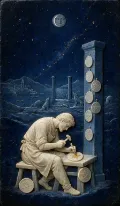 Eight of PentaclesShares: The gold star on the crown · Gold crescents on the shoulders · The walled city behind
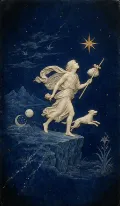 The FoolShares: The gold star on the crown · Gold crescents on the shoulders
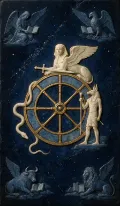 Wheel of FortuneShares: The ivory sphinx · Two spoked wheels
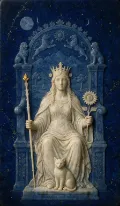 Queen of WandsShares: The winged gold disc · Gold crescents on the shoulders